
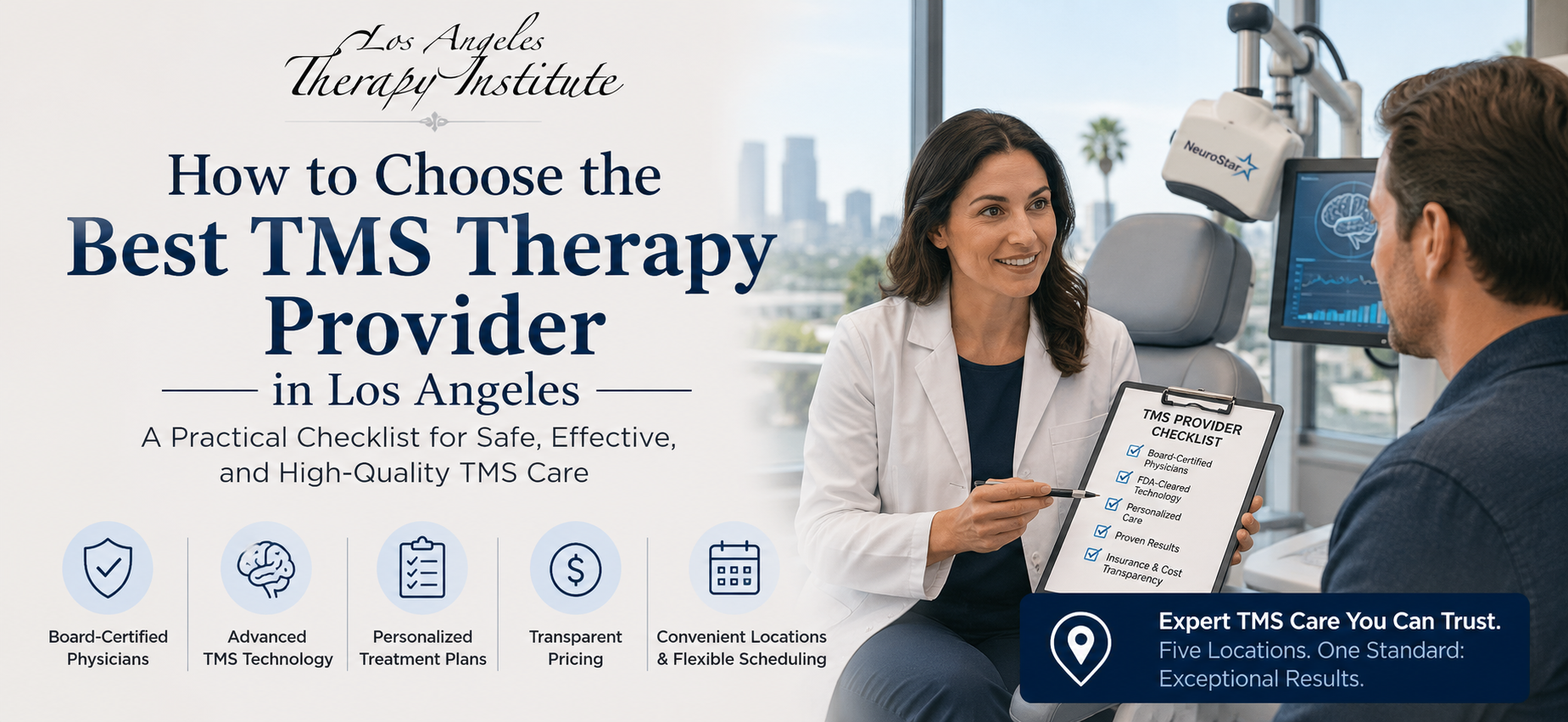
A quick search for TMS clinics near you probably pulled up a dozen results, all claiming to be the best. Every site has the same stock photos of a smiling patient in a treatment chair, the same promises of life-changing results, and no real way to tell them apart.
That’s the problem. TMS is a medical procedure, not a spa service, and the provider you choose affects how well it works. A clinic with an inexperienced tech running the machine and a psychiatrist who signs off remotely is a different experience than one with a physician present and a plan built around your specific diagnosis.
This guide walks through what actually separates the best TMS therapy providers from the rest, using the same criteria clinicians and patient advocacy groups use to vet clinics.
Objective: Give Los Angeles patients a practical, credential-based checklist for evaluating TMS providers, so they can identify a clinic that meets clinical standards rather than one that just has the best ad budget, and connect them with Los Angeles Therapy Institute as a vetted option.
Table of Contents
Key Takeaways
- The best TMS therapy providers are led by board-certified psychiatrists or physicians, not technicians working without direct physician oversight.
- Equipment matters. Ask specifically what system a clinic uses, since not every TMS device has the same FDA clearances or track record.
- TMS cost in Los Angeles typically runs $10 to $70 per session with insurance, and a full course includes 36 sessions plus one mapping session.
- A legitimate provider gives you an individualized treatment plan, not a fixed protocol applied to everyone.
- Los Angeles Therapy Institute offers NeuroStar TMS across five Southern California locations with a free 30-minute consultation to evaluate fit before you commit.
What Should “Good” TMS Actually Look Like?
A quality TMS provider combines three things: a credentialed physician overseeing your care, equipment backed by real clinical data, and a treatment plan built around your diagnosis instead of a generic script.
Miss any one of those three, and you’re gambling with a treatment that’s supposed to be precise. TMS works by targeting a specific brain region at a specific pulse intensity. Get the mapping wrong, or skip proper patient screening, and results suffer.
At Los Angeles Therapy Institute, TMS is delivered under the direction of a physician team that includes an MD who oversees treatment protocols, alongside licensed clinical psychologists and therapists who coordinate care. That structure isn’t decorative. It’s the difference between a clinic that treats TMS as a real medical intervention and one that treats it as a walk-in service.
Are the Physicians Board-Certified?
Yes, this should be your first question, and a legitimate clinic will answer it without hesitation. Board certification in psychiatry or neurology confirms the physician completed accredited training and ongoing education specific to brain-based treatment.
Certification alone doesn’t guarantee a good experience, but its absence is a red flag. TMS requires understanding how psychiatric medications interact with treatment, how to screen for seizure risk, and how to adjust protocols when a patient isn’t responding.
Questions worth asking directly:
- Is a licensed physician involved in my evaluation and ongoing care, not just the initial sign-off?
- How many years has this specific provider been administering TMS?
- What professional organizations, such as the Clinical TMS Society, is the practice affiliated with?
A provider who answers these clearly, without deflecting to “our team” in vague terms, is usually one worth trusting.
What Equipment Does the Clinic Use?
Not all TMS machines carry the same FDA clearances. NeuroStar, the system used at Los Angeles Therapy Institute, is cleared for major depressive disorder, OCD, anxious depression, and, as of 2024, adolescent depression ages 15 to 21.
Other systems, like Deep TMS devices, have separate and sometimes narrower approval histories. Asking what equipment a clinic uses, and what it’s specifically cleared to treat, tells you whether the provider’s marketing matches their actual capability.
A few equipment questions that matter more than they sound:
- Does the system use contact sensing or neuronavigation to keep the coil correctly positioned throughout the session?
- How many total treatments has this specific device delivered across the provider’s patient base?
- Is the machine cleared for your specific diagnosis, or only for a related condition?
NeuroStar alone has delivered more than 6 million treatments nationally, which gives providers using it a wide base of outcome data to draw from when adjusting their protocol.
Is the Treatment Plan Personalized?
No two patients should get the exact same TMS protocol. A provider who proposes a fixed number of sessions before even reviewing your history is applying a template, not a plan.
Your first appointment should include a brain mapping session that sets pulse intensity and target location specifically for you. From there, a good provider tracks your response weekly and adjusts frequency, intensity, or duration if progress stalls.
Signs a provider is personalizing care rather than running a script:
- They ask about your full medication history, not just your current diagnosis
- They explain how they’ll measure progress, not just how many sessions you’ll get
- They’re upfront that responses vary and some patients need protocol adjustments mid-course
- They coordinate with your existing therapist or psychiatrist rather than working in isolation
What Is TMS Cost in Los Angeles, Really?
TMS cost in Los Angeles varies widely depending on insurance coverage, and any provider who won’t give you a straight answer before you book is worth reconsidering.
With insurance, most patients pay $10 to $70 per session, depending on their plan’s deductible and copay structure. A full course runs 36 sessions plus one mapping appointment, which puts the total session count firmly in a predictable range.
Los Angeles Therapy Institute accepts Aetna, Cigna, Blue Shield of California, Anthem Blue Cross, UnitedHealthcare, Optum, Health Net, Medicare, and Medi-Cal, which recently expanded coverage to include TMS treatment.
Without insurance, out-of-pocket pricing should be disclosed clearly and often becomes more affordable when sessions are purchased in bulk or paid upfront. Some clinics charge upward of $300 per session out of pocket elsewhere in the industry, so getting exact numbers before starting matters.
A provider offering a free consultation before any financial commitment, which is standard at the Institute, gives you room to compare real numbers instead of guessing.
Provider Checklist: Questions to Ask Before You Book
Use this table as a working checklist. Bring it to your consultation call and see how many boxes each provider actually checks.
| Category | What to Ask | Green Flag Answer |
| Credentials | Is a board-certified physician overseeing my care? | Yes, named and available to discuss your case |
| Equipment | What TMS system do you use, and what’s it cleared for? | Specific device name, matched to your diagnosis |
| Personalization | How is my treatment plan built? | Individualized mapping and progress tracking |
| Insurance | What will this cost with my specific plan? | Clear number after a benefits check, before you start |
| Experience | How many patients have you treated with TMS? | Specific figures, not vague reassurance |
| Location | How many locations, and how far is my nearest one? | Multiple accessible sites for a 5-day weekly commitment |
Red flags to watch for:
- Pressure to commit before a proper evaluation
- Vague answers about which physician actually oversees treatment
- No clear explanation of what happens if the initial protocol doesn’t work
- Reluctance to discuss cost until after you’ve scheduled
Does Location and Scheduling Actually Work for You?
A full TMS course means showing up five days a week for 4 to 6 weeks. Distance matters more here than for a typical therapy appointment.
Los Angeles Therapy Institute operates across five Southern California locations: two in Santa Monica, one in Beverly Hills, one on Sepulveda Boulevard in Los Angeles, and one in Orange County. That spread matters if you’re commuting from the Westside versus Orange County, since a 45-minute drive each way, five days a week, adds up fast and can affect whether you stick with treatment.
Ask any provider you’re considering how many locations they operate and whether appointment times realistically fit around your work schedule. A clinic that only offers mid-day slots isn’t going to work for someone with a 9-to-5 job, no matter how good their equipment is.
Finding the Right Fit
Choosing a TMS provider isn’t about finding the flashiest website. It’s about confirming a real physician is involved, the equipment has a track record, and the cost is clear before you start.
Los Angeles Therapy Institute meets each point on this checklist, from board-involved oversight to transparent, insurance-backed pricing across five convenient locations. Call 3108574946 or book a free 30-minute consultation to see how the practice measures up against your own list.
Frequently Asked Questions
How do I know if a TMS provider is legitimate?
Check that a board-certified physician oversees care, ask what equipment they use and what it’s FDA-cleared for, and confirm they’ll walk you through insurance costs before you commit to anything.
Is cheaper TMS always a worse option?
Not necessarily, but a price far below the typical $10 to $70 per session with insurance is worth questioning. Ask what’s included, since some low quotes exclude the mapping session or use less experienced staff.
Can I switch TMS providers mid-treatment if it's not working?
Yes, though it’s smoother to raise concerns with your current provider first. A protocol adjustment often solves the issue without needing to restart elsewhere.
Does a more expensive provider mean better results?
Not automatically. Cost differences often come down to insurance negotiation and overhead, not treatment quality. Credentials and equipment matter more than price alone.
How long does it take to find out if TMS is working?
Most providers reassess around week three or four of a standard 4 to 6 week course. If a clinic can’t tell you how they’ll measure progress, that’s worth asking about directly.