
Search “therapist in Santa Monica,” and you’ll get hundreds of results, most with a headshot, a soft-focus office photo, and a list of specialties that somehow covers everything from childhood trauma to executive burnout. That’s not helpful when you’re trying to figure out who actually fits your situation.
Santa Monica has one of the highest concentrations of licensed therapists in Los Angeles County. That’s good news in theory. In practice, it means the search itself becomes its own kind of overwhelming, especially if you’re already dealing with something hard enough without adding decision fatigue on top of it.
This blog breaks down what actually matters when narrowing that list, from neighborhood logistics to what a real first session looks like.
Objective: Help Santa Monica residents narrow down their search for a therapist by neighborhood, specialty, and practical fit, and position Los Angeles Therapy Institute as a trusted local option with two Santa Monica offices.
Table of Contents
Key Takeaways
- Therapy in Santa Monica is dense with options, which makes fit, not just credentials, the deciding factor for most people.
- Location matters more than people expect. A therapist in Santa Monica near Ocean Park is a different daily commute than one near Wilshire Montana.
- Most therapists here specialize, so matching your specific need, anxiety, couples work, trauma, to a therapist’s actual focus saves months of trial and error.
- Insurance coverage varies widely by practice. Confirming this before your first call prevents a wasted consultation.
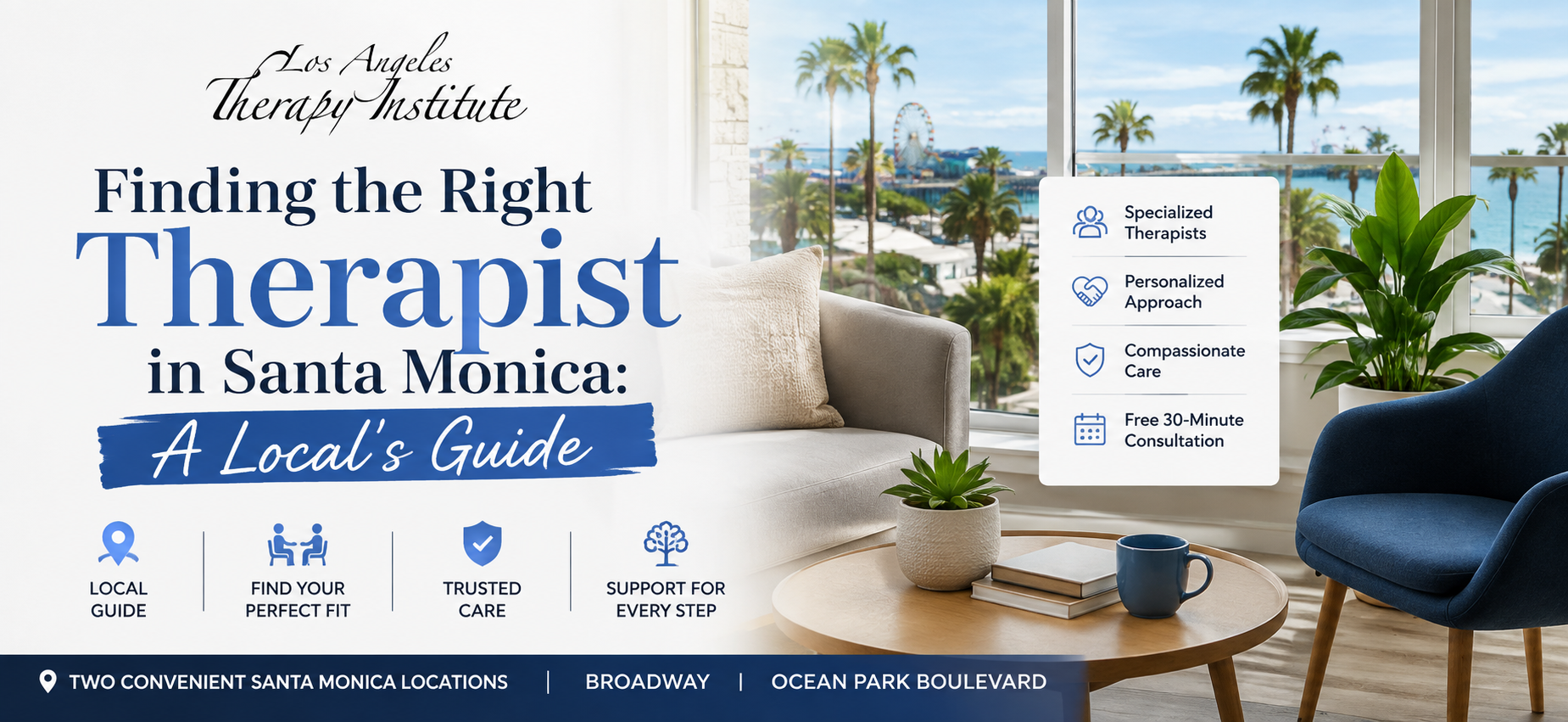
- Los Angeles Therapy Institute operates two Santa Monica locations, on Broadway and Ocean Park Boulevard, both offering a free 30-minute consultation before you commit.
Why Does Location Actually Matter in Santa Monica?
Location matters because therapy works best with consistency, and a fifteen-minute commute difference is often the gap between someone who shows up weekly and someone who cancels half their sessions.
Santa Monica isn’t one uniform grid. Downtown Santa Monica, the stretch around the Third Street Promenade and Broadway, tends to draw people who want to combine an appointment with errands or a coffee stop. Ocean Park, further south near the beach, has a slower, more residential pace that some people find easier to settle into before a session.
Further north, Wilshire Montana and North of Montana are walkable, upscale areas closer to Montana Avenue’s shops and cafes. Sunset Park, near Santa Monica College, tends to have easier parking and a more low-key neighborhood feel.
A few practical questions worth asking before you book anything:
- Can you realistically get there weekly, not just for a first session?
- Is street parking manageable, or does the office offer a validated lot?
- Would a lunchtime slot near work make more sense than an evening one near home?
Los Angeles Therapy Institute runs two Santa Monica offices specifically to cover this. One sits at 127 Broadway, close to Downtown. The other is at 3301 Ocean Park Boulevard, closer to the Ocean Park and Sunset Park border.
What Should You Look for in a Therapist Here?
Look for a therapist whose actual clinical focus matches your situation, not just someone with a license and an open slot on their calendar.
A lot of directories make every therapist look interchangeable. They’re not. Someone trained heavily in CBT for anxiety isn’t necessarily the right fit for processing a difficult divorce, even if both fall under “individual therapy” on paper.
A short checklist that actually narrows things down:
- Do they specialize in your specific concern, or list it as one of fifteen general areas?
- Are they licensed in California, and how long have they practiced?
- Do they take your insurance, or offer a sliding scale if they’re out of network?
- Does their approach, CBT, DBT, psychodynamic, match how you actually want to work through things?
At LATI, therapists are grouped by specialty rather than treated as generalists. That includes CBT and DBT-trained clinicians, Gottman-oriented couples therapists, and specialists in trauma, OCD, and depression, so the match happens before you’re three sessions in and realizing it’s not working.
What Types of Therapy Are Available Locally?
Santa Monica therapists generally fall into a handful of categories: individual therapy, couples and family therapy, specialized modalities like EMDR, and more recently, TMS for treatment-resistant depression.
Individual therapy remains the most common starting point, usually for anxiety, depression, or a specific life transition. Couples therapy is its own specialty entirely, and a therapist who’s excellent one-on-one isn’t automatically equipped to referee two people in the same room.
| Therapy Type | Best Fit For | Typical Session Length |
| Individual Therapy | Anxiety, depression, life transitions, personal growth | 45-50 minutes |
| Couples Therapy | Communication issues, trust repair, pre-marital work | 50-60 minutes |
| Family Therapy | Parent-child conflict, adolescent behavioral issues | 50-60 minutes |
| TMS Therapy | Depression unresponsive to medication or talk therapy | 30-60 minutes, several weeks |
Los Angeles Therapy Institute also offers Yoga Therapy as a complementary option for clients who want a body-based practice alongside talk therapy, which isn’t something every Santa Monica practice provides.
How Much Does Therapy in Santa Monica Cost?
Therapy in Santa Monica typically runs $150 to $300 per session out of pocket, though the actual number depends heavily on whether a practice accepts your insurance.
Cost is usually the question people ask last and worry about most. A practice that’s transparent about pricing upfront, rather than making you sit through a full consultation to find out, saves everyone time.
Insurance coverage varies by practice, so confirm these specifics before booking:
- Is the therapist in-network with your specific plan, or out-of-network with a superbill option?
- Does the practice verify your benefits for you, or is that on you to figure out?
- Are there sliding-scale spots available if you’re paying out of pocket?
LATI accepts a range of major insurance providers, including Aetna, Cigna, UnitedHealthcare, Optum, Health Net, Anthem Blue Cross, and Medi-Cal, and the practice’s team handles benefit verification directly rather than leaving clients to call their insurer and decode it alone.
How Do You Know It’s Time to Start Looking?
Most people wait longer than they should before calling a therapist, usually until a specific moment forces the decision rather than a gradual buildup of stress.
That moment looks different for everyone. Sometimes it’s a panic attack in a parking lot. Sometimes it’s a partner saying they’re done trying to fix things alone. Sometimes it’s just waking up exhausted for the fortieth day in a row and realizing that’s not normal anymore.
Signs it’s worth reaching out sooner rather than later:
- Sleep or appetite has changed noticeably over the past few weeks
- Something that used to feel manageable now feels constant
- A relationship keeps circling the same unresolved argument
- Work or daily tasks feel harder to start than they used to
None of these require a crisis to justify calling. A therapist in Santa Monica can be useful well before things reach a breaking point, and earlier support usually means fewer sessions needed overall.
What Should Your First Session Look Like?
A first session should feel like an assessment, not a full deep dive. Most therapists spend it gathering history and figuring out whether they’re actually the right fit for you.
Expect questions about what brought you in, relevant background, and what you’re hoping therapy accomplishes. A good therapist will also be upfront if they think a colleague might be a better match for your specific situation, rather than keeping every client regardless of fit.
Los Angeles Therapy Institute offers a free 30-minute consultation before any paid session, specifically to handle this matching step without cost or pressure attached. That’s a meaningful difference from practices that only offer a paid intake as your first point of contact.
Start Where You Actually Are
The right therapist isn’t the one with the best website. It’s the one whose specialty matches your situation, whose office you’ll actually get to consistently, and who you feel comfortable being honest with.
Los Angeles Therapy Institute has two Santa Monica locations, on Broadway and Ocean Park Boulevard, and offers a free 30-minute consultation to help you find that fit before committing to anything. Call 3108574946 or book online to get started.
Frequently Asked Questions
How do I find a good therapist in Santa Monica?
Start with your specific need, not a general directory search. Look for someone who lists your concern as a specialty rather than one item on a long general list, and confirm they’re licensed in California.
Is therapy in Santa Monica covered by insurance?
Often, yes, though coverage depends entirely on the practice and your specific plan. Ask directly whether they’re in-network before booking, since out-of-network costs add up fast.
How long does it take to find the right therapist?
It varies, but most people know within two or three sessions whether a therapist feels like a fit. A free consultation beforehand, where available, cuts that trial period down significantly.
Can I switch therapists if the first one isn't working?
Yes, and it’s common. A therapist not being the right fit isn’t a failure on your part. Most practices, LATI included, can match you with someone else on their team without starting the intake process from scratch.
Do I need a referral to see a therapist in Santa Monica?
No referral is required for most therapy in California. You can contact a practice directly, though your insurance plan may have its own requirements worth checking first.