
You’ve tried the breathing exercises. You’ve tried the medication, or maybe two or three different ones, each with its own list of side effects. Your therapist is good, but three years in, the racing thoughts still show up at 2 a.m.
If that sounds familiar, you’ve probably come across TMS therapy in Los Angeles clinics advertising as a next step. The pitch sounds almost too simple: magnetic pulses, no drugs, no downtime. Naturally, the first question is whether it actually works for anxiety, or if it’s mostly marketed that way.
This guide breaks down what TMS for anxiety in Los Angeles patients can realistically expect, based on current FDA clearances and clinical research, not sales copy.
Objective: Help Los Angeles residents searching for anxiety relief understand what TMS therapy actually treats, what the FDA has and hasn’t cleared it for, and whether it’s a realistic option for their situation, so they can make an informed decision about booking a consultation with Los Angeles Therapy Institute.
Key Takeaways
- TMS is not FDA-cleared as a standalone treatment for generalized anxiety disorder. It’s cleared for major depressive disorder, OCD, and for reducing anxiety symptoms in adults with anxious depression.
- If your anxiety shows up alongside depression, or hasn’t responded to medication or talk therapy, TMS for anxiety in Los Angeles may be worth exploring.
- A full course runs about 4 to 6 weeks, with sessions lasting 30 to 60 minutes.
- Most major insurers, including Medi-Cal as of this year, now cover TMS treatment, with per-session costs often between $10 and $70 for insured patients.
- Los Angeles Therapy Institute offers NeuroStar TMS therapy across five Southern California locations, backed by a free 30-minute consultation to assess fit.
What Is TMS Therapy?
TMS, short for Transcranial Magnetic Stimulation, is a non-invasive treatment that uses magnetic pulses to stimulate specific regions of the brain involved in mood regulation.
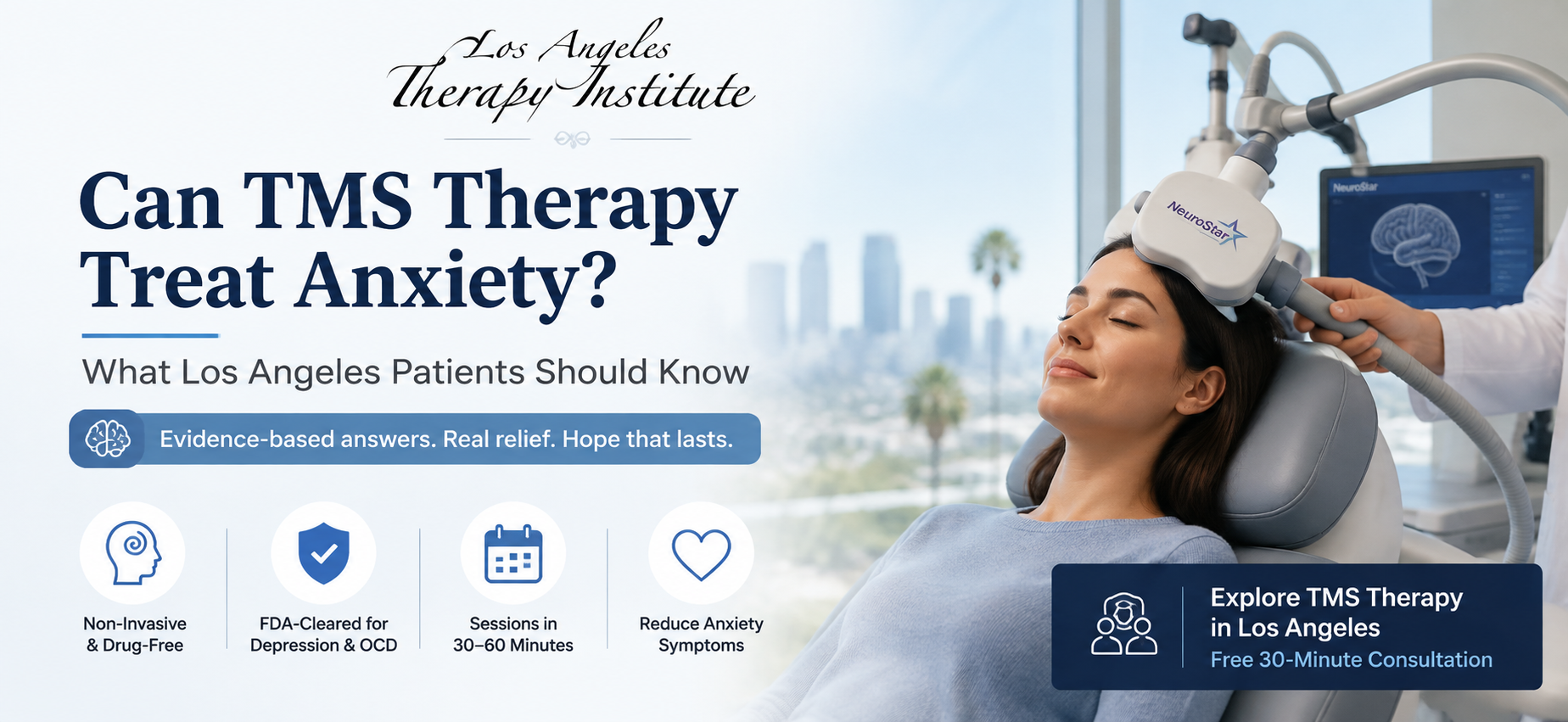
A coil rests against the scalp and delivers repetitive pulses to the brain’s dorsolateral prefrontal cortex, an area that tends to be underactive in people with depression. Sessions take place while you sit in a chair, fully awake, and you can drive yourself home afterward.
At Los Angeles Therapy Institute, treatment is delivered through NeuroStar Advanced Therapy, one of the most studied TMS systems on the market. The technology first received FDA clearance in 2008 for treatment-resistant depression, and its approved uses have expanded steadily since.
TMS therapy in Los Angeles patients receive at the Institute is available across five locations: Santa Monica, Beverly Hills, and Orange County, plus a Los Angeles office on Sepulveda Boulevard.
Can TMS Actually Treat Anxiety?
Not as a standalone diagnosis. TMS is FDA-cleared to reduce anxiety symptoms specifically in adults who have major depressive disorder with comorbid anxiety, often called anxious depression.
That distinction matters, and it’s one a lot of marketing pages gloss over. If your anxiety exists on its own, without a depression diagnosis attached, TMS hasn’t cleared FDA review for that use yet. Research on TMS for generalized anxiety disorder and social anxiety is ongoing, with several multi-site trials in progress, but the evidence is still building.
Here’s where it gets useful. Depression and anxiety travel together more often than not. Somewhere between 60% and 90% of people with depression also experience moderate anxiety, and roughly a quarter deal with more severe symptoms. If that’s your situation, and standard antidepressants haven’t gotten you far enough, TMS for anxiety in Los Angeles treatment centers offers a genuinely relevant option, not a stretch.
A 2025 review of 573 patients across 11 studies found that TMS produced measurable, consistent reductions in anxiety symptoms among people with anxious depression. That’s the evidence base worth paying attention to, not the broader claims some clinics make.
How Does TMS Work on an Anxious Brain?
Anxiety and depression both involve disrupted activity in brain circuits that regulate mood, threat response, and emotional processing. TMS targets these circuits directly, using magnetic pulses to increase activity in underactive regions.
Think of it less like flipping a switch and more like physical therapy for the brain. One session won’t change much. Repeated sessions, delivered consistently over weeks, gradually retrain how these circuits fire.
Unlike medication, TMS doesn’t circulate through your bloodstream or interact with your liver and kidneys. It works locally, on the targeted brain region, which is part of why the side effect profile looks so different from antidepressants.
Patients typically describe the sensation as a light tapping or clicking on the scalp. Most tolerate it well and return to work or errands the same day.
Who Is a Good Candidate for TMS?
TMS tends to make the most sense for a specific group of patients, not everyone dealing with anxiety.
Good candidates often include people who:
- Have been diagnosed with major depressive disorder alongside anxiety symptoms
- Have tried one or more antidepressants without adequate relief
- Want to avoid the systemic side effects that come with medication, like weight gain or drowsiness
- Have completed, or are currently in, talk therapy without full symptom relief
- Do not have a personal or family history of seizure disorders
TMS is generally not appropriate for patients who:
- Have metal implants near the head, such as certain aneurysm clips
- Have a seizure disorder or history of seizures
- Have not yet tried standard first-line treatments, in most insurance scenarios
A licensed clinician at Los Angeles Therapy Institute reviews your medical history, current medications, and treatment history before recommending TMS. This isn’t a treatment you self-select into. It’s one your care team helps you qualify for.
What Does a TMS Treatment Timeline Look Like?
A full course of TMS therapy in Los Angeles patients complete generally follows this pattern:
- Brain mapping session. Your first appointment locates the precise treatment area and sets your pulse intensity. This session alone doesn’t produce results, it calibrates the machine to you.
- Daily sessions begin. Most protocols call for five sessions a week, each lasting 30 to 60 minutes.
- Course length. A typical course runs 36 sessions over 4 to 6 weeks.
- Symptom check-ins. Your clinician tracks progress throughout, adjusting as needed.
- Maintenance planning. Some patients benefit from periodic booster sessions after the initial course ends.
There’s no anesthesia, no recovery time, and no restriction on driving yourself to and from appointments. That’s a meaningful difference for patients juggling work schedules around treatment.
TMS vs. Medication vs. Talk Therapy
None of these approaches cancels out the others. Many patients combine two, or work through them in sequence. Here’s how they compare on the factors that usually matter most.
| Factor | TMS Therapy | Antidepressant Medication | Talk Therapy (CBT/DBT) |
| Invasiveness | Non-invasive, no drugs | Systemic, taken daily | Non-invasive |
| Common side effects | Mild scalp discomfort, headache | Weight gain, nausea, fatigue | None physical |
| Time to see change | Often 3-6 weeks | 4-8 weeks, varies | Weeks to months |
| Daily commitment | 30-60 min, 5x/week for 4-6 weeks | Daily pill | Weekly sessions |
| FDA status for anxiety | Cleared for anxious depression only | Varies by drug and diagnosis | Not FDA-regulated |
Individual therapy remains a foundational piece of anxiety treatment regardless of what else is added. Many patients at the Institute pair TMS with ongoing CBT or DBT sessions rather than choosing one over the other.
What Does TMS Cost in Los Angeles?
Cost is usually the first practical question after “does it work,” so here’s a straightforward breakdown.
With insurance:
- Per-session cost typically runs $10 to $70, depending on your plan
- A full course includes 36 treatment sessions plus one brain mapping session
- Deductibles and copays still apply, and vary by insurer
Insurance accepted at Los Angeles Therapy Institute includes Aetna, Cigna, Blue Shield of California, Anthem Blue Cross, UnitedHealthcare, Optum, Health Net, Medicare, and Medi-Cal, which recently approved TMS coverage after months of advocacy work by the practice.
Without insurance:
Out-of-pocket pricing is available, and tends to be more manageable when sessions are paid for upfront or in bulk. The billing team walks patients through a full benefits investigation before treatment starts, so there are no surprise costs mid-course.
If cost or coverage feels like the main barrier, that’s exactly what the free consultation is for. You’ll get a clear answer on your specific plan before committing to anything.
Getting Started
Anxiety that hasn’t responded to the usual playbook doesn’t mean you’re out of options. It means the next option needs to fit your specific situation, which is exactly what a real evaluation is for.
Los Angeles Therapy Institute offers a free 30-minute consultation to review your history and determine whether TMS for anxiety in Los Angeles treatment makes sense for you, alongside therapy, medication, or as a next step after both. Call 3108574946 or book online to get a clear, honest answer about your options.
Is TMS FDA-approved for anxiety on its own?
Not yet. It’s cleared for anxiety symptoms tied to major depressive disorder, not generalized anxiety disorder by itself. Research on standalone anxiety use is ongoing.
How many TMS sessions until I notice a difference?
Many patients report early changes around the third or fourth week, though a full course usually runs 36 sessions to see lasting results.
Does TMS hurt?
No. Most people feel a light tapping sensation on the scalp during pulses. There’s no anesthesia involved, and you can resume normal activities right after each session.
Will my insurance cover TMS in Los Angeles?
Most major insurers cover it when medical necessity criteria are met, typically documented attempts at medication that didn’t provide lasting relief. Medi-Cal now covers it too.
Can I keep taking my anxiety medication during TMS treatment?
Yes. TMS is commonly used alongside existing medication and therapy rather than as a replacement. Your treatment team will coordinate this as part of your care plan.