
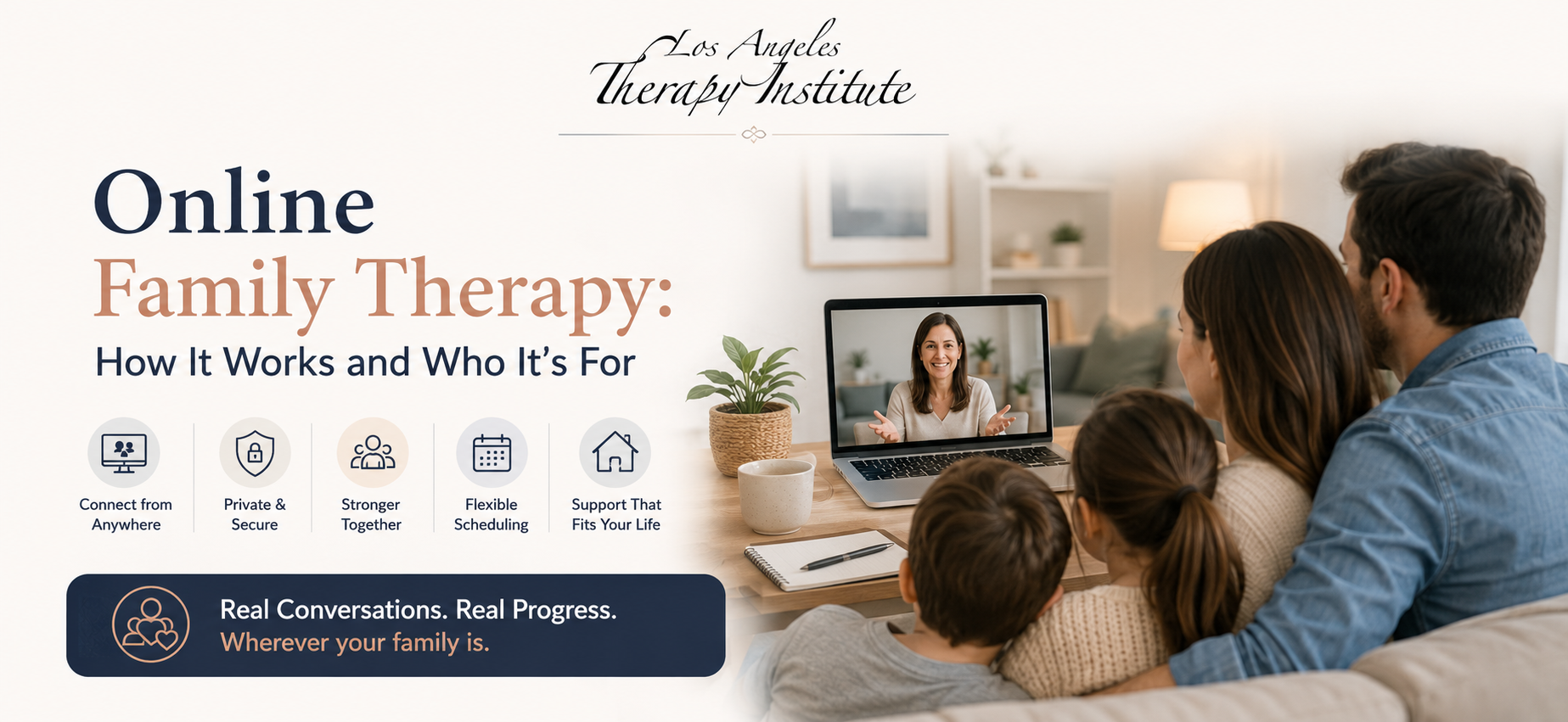
A teenager who won’t come out of her room for a family dinner will sometimes show up for a video call from her own bed, camera on, actually talking. That’s not a fluke. It’s one of the quieter reasons family therapy online has caught on with households that couldn’t make consistent progress any other way.
Getting four or five schedules into one waiting room is hard. One parent works nights. A college kid is three states away. A teenager has practice until 6 pm on the one evening everyone else is free. Video sessions solve a logistics problem that used to keep families from starting therapy at all.
This guide walks through how the format actually works, what you need on your end, and the situations where meeting in person still makes more sense.
Objective: Help families understand what a family therapy online session actually looks like, what they need on their end to make it work, and when it’s worth choosing an in-person visit instead.
Key Takeaways
- Family therapy online uses secure video calls to bring the whole household into a session, no matter where each person is sitting.
- Sessions run on the same structure as in-person therapy. The main differences are the screen and a few tech basics.
- A private room, stable internet, and a device with a camera cover most of what you need.
- HIPAA-compliant platforms keep sessions confidential, similar to the privacy protections of an in-office visit.
- Online couples therapy works especially well for partners with conflicting schedules or one person who travels often.
- In-person sessions are usually the better call for young children, active safety concerns, or families who struggle to stay focused on a screen.
- Los Angeles Therapy Institute offers both online and in-person options, so families can switch formats as needs change.
What Is Family Therapy Online?
Family therapy online is a live video session with a licensed therapist, structured the same way an in-office visit would be. The only difference is the room. Everyone joins from wherever they are, using a phone, tablet, or computer.
It’s not a recorded course or a self-guided app. A real therapist leads the conversation in real time, asks questions, and responds the way they would across a desk.
Most practices, including Los Angeles Therapy Institute, treat online and in-person sessions as equally valid options rather than a downgrade from “real” therapy. Families often start online, meet in person for a session or two, then switch back depending on what a given week looks like.
How Does a Session Actually Work?
The format follows a familiar rhythm once you’ve done it once or twice.
- You get a secure link before the session. No app download is usually required, though some practices offer one for convenience.
- Everyone joins from their own device, or together on one screen. Families in the same house often gather around a laptop. Long-distance family members join separately.
- The therapist opens with a check-in. Same as in person, this sets the tone and surfaces what’s most pressing that week.
- The session runs 45 to 60 minutes, depending on the practice and the family’s needs.
- The therapist may assign something to try before the next session. A conversation to have, a boundary to test, a pattern to notice.
Nothing about the clinical work changes. The therapist still reads body language, still redirects when a conversation gets heated, still holds space for the person who’s struggling to speak up.
What You Need: Tech and Privacy Requirements
The technical bar for family therapy online is lower than most people expect.
| Requirement | What It Looks Like |
| Device | Smartphone, tablet, or computer with a working camera and microphone |
| Internet | A stable connection, ideally wifi rather than mobile data |
| Space | A private room where conversations won’t be overheard |
| Platform | HIPAA-compliant video software, usually provided by the practice |
| Headphones | Optional, but useful when multiple people are in the same house on separate calls |
The bigger requirement isn’t technical. It’s a room where nobody feels like they’re performing for someone standing in the doorway. A shared living room with siblings walking through mid-session undercuts the whole point. A bedroom with the door closed, or a parked car in the driveway, often works better than people assume.
Is It Actually Private?
This is usually the first question families ask, and it’s a fair one.
Legitimate therapy practices use HIPAA-compliant video platforms, not standard consumer apps like FaceTime or regular Zoom accounts. These platforms encrypt the call and don’t store recordings unless everyone explicitly agrees to it.
Family therapy online carries the same confidentiality protections as an in-office session. What’s said in the room, or on the call, stays between the family and the therapist, with the usual legal exceptions around safety that apply to any therapy setting, online or off.
The one variable a practice can’t control is your home environment. If younger siblings can wander in, or a partner is within earshot in another online couples therapy setup, that’s worth solving before the first session rather than during it.
Who Benefits Most From Family Therapy Online?
Certain situations make the online format a genuinely better fit, not just a convenient one.
- Families spread across different locations. A young adult away at college can join the same session as parents and siblings back home.
- Parents with unpredictable or conflicting work schedules. Fitting five people into one waiting room gets easier when nobody has to drive anywhere.
- Teenagers who shut down in unfamiliar settings. Some teens open up faster from a space they already feel safe in.
- Couples using online couples therapy alongside broader family sessions. Partners working through their own dynamic can meet separately from full family sessions without adding another commute to the week.
- Families managing mobility or health limitations. Skipping the drive removes a real barrier for some households.
None of this means online is automatically the right call for every family. It’s the right call for families where logistics were the main thing standing between them and consistent sessions.
When Should You Choose In-Person Instead?
Video sessions aren’t the right fit for every situation, and a good therapist will say so directly.
- Active safety concerns. If there’s current domestic violence or a child at risk, in-person sessions let a therapist read the room and intervene in ways a screen doesn’t allow.
- Young children. Kids under 7 or 8 often struggle to stay engaged on video. Play therapy and in-person observation tend to work better for this age group.
- Severe conflict that escalates quickly. Some families need a therapist physically present to de-escalate tension before it spirals.
- Limited privacy at home. If no one in the household has a quiet, private space to talk, an office removes that obstacle entirely.
- Technology barriers. Spotty internet or unfamiliarity with video platforms can turn sessions into a tech support call instead of therapy.
A good therapist will flag any of these during an initial consultation and recommend switching formats if the fit isn’t right. It’s not a failure on the family’s part. It’s just matching the format to the situation.
What to Expect at Los Angeles Therapy Institute
Los Angeles Therapy Institute offers both online and in-person Child, Adolescent, and Family Therapy, so families aren’t locked into one format for the life of their treatment. Therapists work collaboratively with the whole family unit, addressing communication breakdowns, behavioral concerns, and the day-to-day friction that builds up between parents and kids.
The same flexibility extends to couples. Partners can pursue online couples therapy on its own or alongside broader family sessions, depending on what the household needs that particular month.
Every new family starts with a free 30-minute consultation. That call is a good time to ask which format, online or in-person, makes the most sense for your specific situation before committing to a schedule.
Final Thoughts
Family therapy online removes the logistics that keep a lot of families from ever making it to a first session. The clinical work doesn’t change. What changes is how much easier it becomes to actually show up, consistently, week after week.
If you’re weighing whether online or in-person sessions make more sense for your family, Los Angeles Therapy Institute offers a free 30-minute consultation to help you figure out the right fit before you commit to anything.
Frequently Asked Questions
Is family therapy online as effective as in-person therapy?
For most families, yes. Research on telehealth therapy generally shows outcomes comparable to in-office sessions, especially for communication-focused work like family and couples therapy. The exceptions are cases involving young children or active safety concerns, where in-person care usually works better.
Can teenagers refuse to turn their camera on?
It happens, and a skilled therapist can usually work with it. Sometimes a teen who won’t show their face will still talk more openly than they would sitting across a desk in an office.
What if only some family members can join a session?
Most therapists can still run a productive session with a partial group, though a full family session usually gets scheduled separately once everyone’s available.
Do I need special software for family therapy online?
Usually not. Most practices send a browser link that works without downloading an app. Your practice will confirm exactly what’s needed before your first session.
Can we switch between online and in-person sessions?
Yes, and many families do. It’s common to start online for convenience, then meet in person occasionally, or switch entirely if a family’s situation changes.