
A couple sits across from each other at dinner, phones out, nothing said for twenty minutes. Neither one is angry. They just ran out of things to say to each other somewhere around year seven.
That’s usually not what brings people into a therapist’s office. It’s smaller than a single fight. It’s the slow realization that two people who used to talk about everything now talk about logistics: the kids’ schedule, whose turn it is to call the plumber, what to eat for dinner.
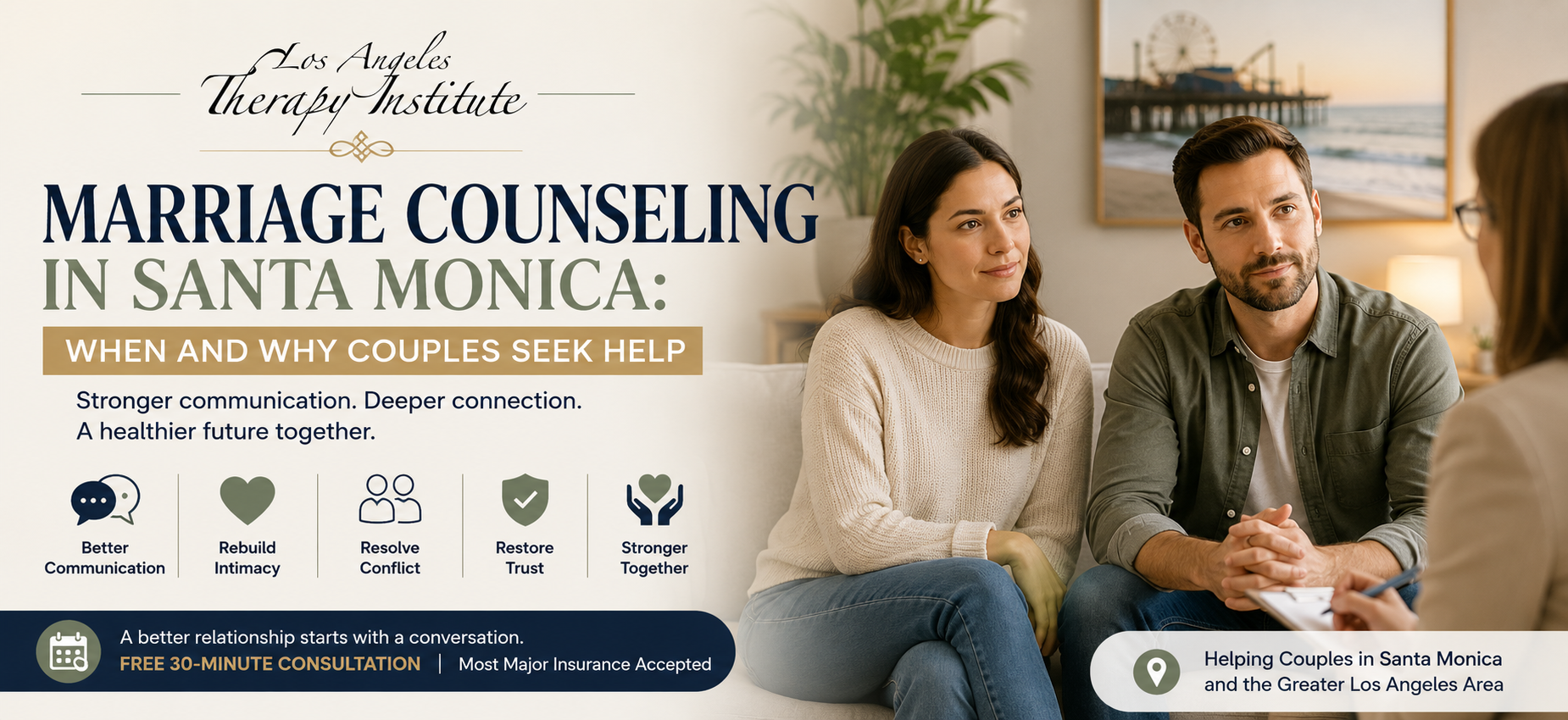
Marriage counseling in Santa Monica exists for exactly this moment, before a marriage becomes a business partnership. This guide covers what counseling actually looks like, the signs that tell you it’s time, and how to find the right therapist for your situation.
Objective: Help engaged and married couples in Santa Monica recognize the warning signs of relationship strain, understand what marriage counseling actually involves, and give them a clear next step through Los Angeles Therapy Institute.
Table of Contents
Key Takeaways
- Marriage counseling in Santa Monica works best when couples start before resentment sets in, not after it has already taken hold.
- The most common warning sign isn’t fighting. It’s silence, when couples stop bringing problems to each other at all.
- Most couples wait an average of six years after problems begin before seeking help, according to Gottman Institute research.
- A qualified relationship therapist in Santa Monica uses structured, evidence-based methods like the Gottman Method, not just open-ended talk sessions.
- Los Angeles Therapy Institute offers a free consultation and accepts most major insurance plans, including Aetna, Cigna, and UnitedHealthcare.
What Is Marriage Counseling in Santa Monica?
Marriage counseling in Santa Monica is structured therapy for couples working through communication breakdowns, trust issues, or emotional distance. A trained therapist guides both partners through specific techniques, not just a moderated conversation.
At Los Angeles Therapy Institute, sessions draw on the Gottman Method, Cognitive Behavioral Therapy (CBT), and Attachment Theory. These aren’t buzzwords. Each approach targets a different part of the problem: the Gottman Method rebuilds communication patterns backed by over 40 years of relationship research, CBT addresses the thought patterns driving repeated arguments, and Attachment Theory looks at how each partner’s early bonding history shows up in how they fight or withdraw today.
Couples come in for a range of reasons. Some are newly married and blindsided by how different marriage feels from dating. Others have been together twenty years and finally ran out of patience for the same argument on repeat. Both groups benefit from the same core process: a therapist who can name what’s happening between them before it gets named as “irreconcilable.”
How Do You Know When It’s Time for Counseling?
You know it’s time when the same argument keeps happening with no resolution, or when you’d rather avoid a topic than bring it up. Both are signs the relationship needs outside support.
Most couples don’t walk in during a crisis. They walk in after months, sometimes years, of a low hum of frustration that never gets addressed. Research from the Gottman Institute found that couples wait an average of six years of being unhappy before seeking help. By then, patterns are calcified and resentment has usually built a case file.
A few situations that typically call for professional support:
- Arguments that end without resolution, just exhaustion
- One or both partners bringing up divorce, even casually
- A major breach of trust, such as infidelity or financial secrecy
- A big life transition (new baby, job loss, relocation) that’s straining the relationship
- Physical intimacy that’s dropped off and neither partner brings it up
None of these mean the marriage is over. They mean the two people in it need a third person in the room who isn’t taking sides.
Warning Signs Couples Wait Too Long to Address
The signs that matter most are usually the quiet ones. Loud fights get attention. Silence doesn’t, and that’s the problem.
| Warning Sign | Why Couples Miss It | What It Usually Means |
| Withdrawal from conversation | Feels like “peace,” not conflict | Partners have stopped believing talking helps |
| Sarcasm replacing direct requests | Sounds like humor | Resentment has built up enough that direct honesty feels risky |
| Parallel lives under one roof | Looks like independence | Emotional disconnect has already set in |
| Defensiveness at small comments | Seems like a bad mood | A pattern of feeling criticized that predates the comment |
| Avoiding physical affection | Chalked up to being “busy” or “tired” | Growing emotional distance, not just a scheduling issue |
Dr. John Gottman’s research identified four communication patterns- criticism, contempt, defensiveness, and stonewalling- as the strongest predictors of divorce when left unaddressed. Contempt in particular- eye-rolling, mockery, or sarcasm aimed at a partner- is the single most damaging of the four. Couples who catch these patterns early and get support tend to have far better outcomes than those who wait until one partner is already emotionally checked out.
How Does Marriage Counseling Actually Work?
Marriage counseling starts with both partners describing the relationship from their own point of view, usually in the first one or two sessions. From there, the therapist identifies recurring patterns and teaches specific tools to interrupt them.
At Los Angeles Therapy Institute, sessions are interactive rather than passive. Instead of two people talking at a silent therapist, the sessions are feedback-driven. A therapist trained in the Gottman Method might walk a couple through building what’s called a “love map,” a structured way of relearning what’s actually going on in your partner’s inner world instead of assuming you already know.
A typical arc looks like this:
- Assessment sessions. The therapist meets with both partners together, then sometimes individually, to understand the history and current friction points.
- Pattern identification. The therapist names the specific cycle the couple gets stuck in, for example, one partner pursues connection while the other withdraws.
- Skill building. Couples learn concrete tools: how to raise a complaint without it turning into an attack, how to take a break from an argument without it becoming stonewalling, how to repair after a fight.
- Practice between sessions. Homework isn’t unusual. Real change happens outside the therapy room, not just inside it.
- Reassessment. Progress gets checked regularly, and the approach adjusts based on what’s working.
This isn’t a quick fix. Most couples see meaningful movement over 8 to 20 sessions, depending on how long the patterns have been in place.
What to Look for in a Relationship Therapist in Santa Monica
Look for a relationship therapist in Santa Monica who is licensed, trained in a specific evidence-based method, and works with both partners directly rather than acting as a referee for one side.
Credentials matter, but so does fit. A therapist can have every certification and still not be the right match for a specific couple’s dynamic. A few things worth asking about before booking:
- What specific approach do you use (Gottman Method, EFT, CBT), and why does it fit our situation?
- How do you handle sessions where one partner is more vocal than the other?
- Do you offer individual sessions alongside couples sessions when needed?
- What does progress typically look like, and by when?
Los Angeles Therapy Institute therapists are evaluated not just on clinical training but on how they actually work with couples in the room: direct, engaged, and willing to name what’s happening rather than staying neutral to a fault. The practice has two Santa Monica locations, at 127 Broadway and 3301 Ocean Park Blvd, making it accessible whether you’re coming from the Pier area or closer to the airport side of the city.
How Much Does Marriage Counseling Cost?
Cost depends on whether you’re using insurance or paying privately, and how often you attend sessions. Most couples in Santa Monica pay between $150 and $300 per session out of pocket, with insurance often reducing that significantly.
| Payment Method | Typical Cost Per Session | Notes |
| Private pay | $150 to $300 | Rates vary by therapist experience and session length |
| In-network insurance | Copay only (often $20 to $50) | Depends on your specific plan |
| Sliding scale | Varies | Not all practices offer this; ask directly |
Los Angeles Therapy Institute accepts most major insurance plans, including Aetna, Cigna, UnitedHealthcare, Optum, Health Net, Anthem, and Medi-Cal. Medi-Cal now also covers TMS treatment for eligible patients, a recent update worth knowing if cost has been the barrier holding you back. For a full breakdown of what to expect, the practice’s guide on couples therapy costs in Los Angeles covers pricing in more detail.
Money is often the reason couples put off getting help. It shouldn’t be the deciding factor when a relationship is on the line, and checking insurance coverage takes a few minutes.
What Happens in Your First Session
The first session is mostly about the therapist understanding your relationship’s history and current pain points, not diving straight into problem-solving.
Expect to spend most of the first meeting talking through how you met, what’s changed, and what specifically brought you in now. It’s normal for this to feel a little exposing. Most couples say the discomfort passes quickly once they realize the therapist isn’t there to assign blame.
Los Angeles Therapy Institute offers a free 30-minute consultation before the first paid session, so couples can get a feel for the therapist and approach before committing. If you’re newly engaged rather than already married, the practice’s guide to pre-marital counseling in Los Angeles is worth a read as well.
Conclusion
The couple that goes quiet at dinner isn’t unusual. Most relationships hit a point where the easy conversations run out, and the hard ones start piling up unsaid. What separates couples who come back from that point from couples who don’t usually isn’t the size of the problem. It’s whether they got help before the silence became permanent.
Marriage counseling in Santa Monica works best as a proactive step, not a last resort. If any of the warning signs above sound familiar, that’s worth paying attention to. Los Angeles Therapy Institute offers a free consultation to help you figure out if counseling is the right next step, with no pressure and no obligation. Book your free consultation today or call 3108574946 to get started.
Frequently Asked Questions
Is marriage counseling in Santa Monica covered by insurance?
Often, yes. Most major insurance plans, including Aetna, Cigna, and UnitedHealthcare, cover at least part of couples counseling. Coverage details vary by plan, so it’s worth a quick call to confirm your specific benefits.
How long does marriage counseling usually take to show results?
Most couples notice some shift within 6 to 8 sessions, though full resolution of long-standing patterns often takes longer. It depends on how deep the issues run and how consistently both partners show up.
Can marriage counseling help if only one partner wants to go?
It can help, but progress is slower and more limited without both partners engaged. Some therapists offer individual sessions first to help the reluctant partner get comfortable with the idea.
What's the difference between marriage counseling and couples therapy?
In practice, not much. Marriage counseling usually refers specifically to legally married couples, while couples therapy covers any committed relationship, including engaged or long-term unmarried partners.
Do we need a referral to see a relationship therapist in Santa Monica?
No referral is required to book a consultation. If you’re planning to use insurance, it’s worth confirming with your provider whether your plan requires one for reimbursement.
Is online marriage counseling as effective as in-person sessions?
For many couples, yes. Research on telehealth couples therapy shows comparable outcomes to in-person sessions, particularly for communication-focused work. Some couples prefer in-person sessions for deeper emotional work.