
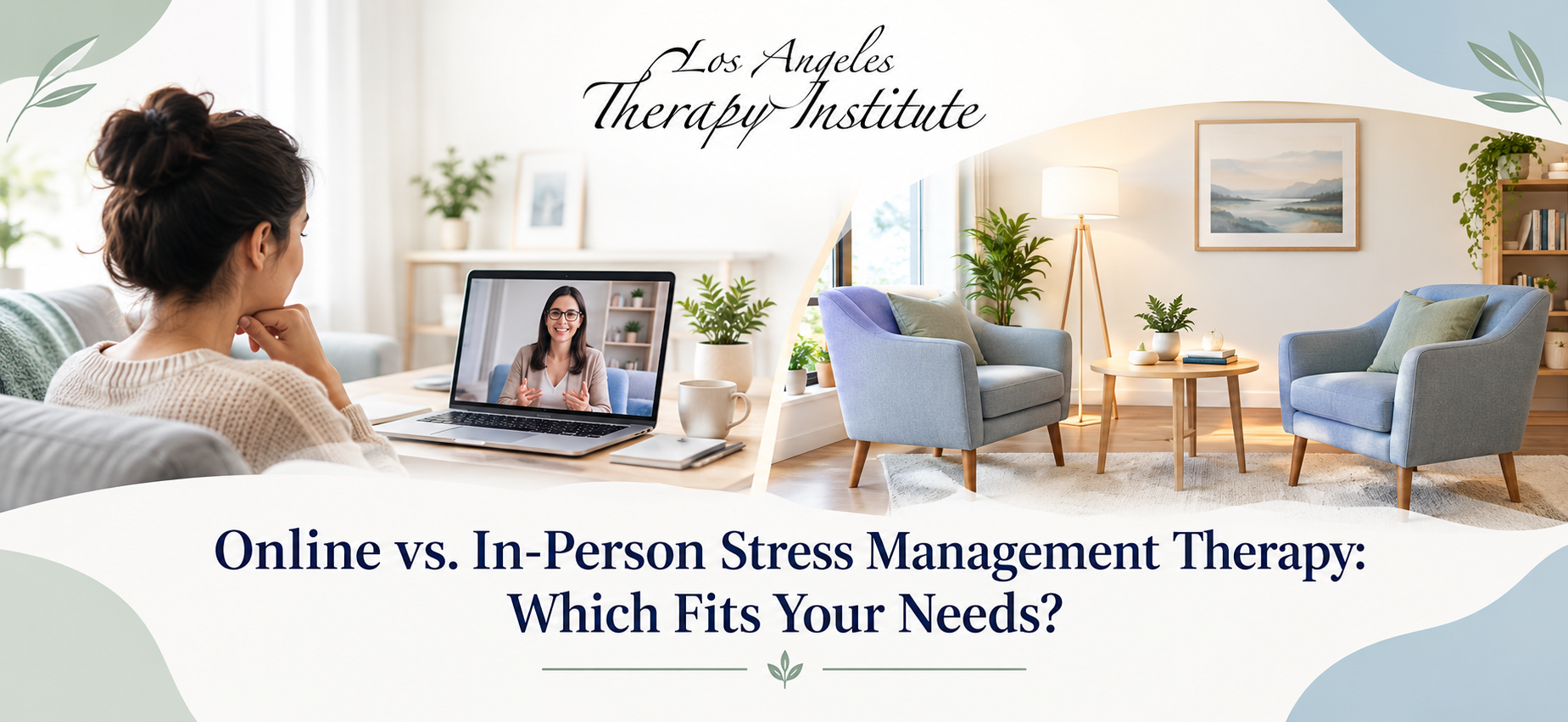
Therapy for stress management can be effective both online and in person, so the option often comes down to your schedule, comfort level and the type of assistance you need.
A 2021 meta-analysis comparing video-based and in-person psychotherapy found that outcomes were broadly similar across the studies reviewed. A later review found that results can vary by condition and treatment method. If you’re considering stress management therapy in Los Angeles, the important question is which format fits your needs and allows you to engage comfortably in treatment. Read the 2021 meta-analysis and the later systematic review.
Los Angeles Therapy Institute offers in-person therapy in Santa Monica and virtual therapy across California. Availability may vary by service, so confirm the options that fit your needs before booking. This guide explains how to compare the formats in plain language.
Objective : This blog explains how online and in-person stress management therapy compare, who tends to do better with each, and how to choose the format that fits your life, with no pressure either way.
Key Takeaways
- Stress management therapy in Los Angeles can help you understand stress patterns and develop practical coping strategies.
- Many therapy approaches can be delivered online or in person, though the session format and how well it suits you may depend on your needs.
- Research suggests that video therapy can produce results comparable to in-person care for several mental health concerns, although findings vary by condition and study.
- In-person therapy may suit people who prefer face-to-face interaction, can’t find a private space for online sessions, or need treatment that requires in-person equipment.
- You can combine both formats, and you can switch later if one stops working for you.
What Is Stress Management Therapy?
Stress management therapy is when you work with a mental health expert who is trained to help you find out what is causing your distress and to help you build healthier ways to respond.
Stress can be induced by work pressures, money difficulties, looking after someone else, marital problems, health issues or major changes in your life. Sometimes numerous things happen at once, and you feel overwhelmed, even if you can’t point to one specific reason.
Therapy can help you explore these experiences without judging yourself for finding them difficult.
Depending on your needs, sessions may focus on:
- Spotting the situations and thoughts that make stress worse.
- Noticing the emotional and physical signs of stress.
- Practicing relaxation, grounding, or mindfulness techniques.
- Communicating better and setting realistic boundaries.
- Building problem-solving skills for difficult situations.
- Looking at patterns that feed ongoing anxiety or low mood.
The approach depends on your circumstances. Stress management therapy is not a promise that stressful situations will disappear. It can help you build ways to navigate them with greater awareness and flexibility.
What’s the Real Difference Between Online and In-Person Stress Management Therapy?
Therapy is pretty similar across formats, but the format is what alters how you participate in each session. In either case, a trained therapist can help you identify what triggers your stress, explore harmful thinking habits, create boundaries, and practice coping techniques. The specific work depends on your goals and treatment plan.
What differs is the experience around the session. Online, you join from a private, quiet location where you can speak freely without interruptions. In person, you travel to an office, sit in the same room with your therapist, and leave your session behind when you walk out the door. Some people feel more comfortable talking face-to-face, while others find it easier to open up in a familiar setting. You can decide based on your own preferences and situation.
| Factor | Online | In person |
| Where | Anywhere private in California | A therapy office |
| Travel | None | Commute and parking |
| Feels like | Familiar, flexible | Focused, separate from home |
| Good for | Tight schedules, distance | Face-to-face connection, shared space |
Does Online Stress Management Therapy in Los Angeles Work as Well as In-Person?
For most people, yes. Studies comparing the two for common concerns like stress, anxiety, and depression keep finding similar improvement. The authors of that 2021 meta-analysis put it simply: therapy is “no less efficacious when delivered via videoconferencing.” A separate 2022 review of trials focused on depression reached a similar conclusion.
The evidence is not identical across all conditions. A systematic review found similar outcomes for video and in-person treatment for PTSD, while its findings suggested a possible advantage for in-person treatment for depression, based on low-quality evidence. The researchers also noted that more studies are needed. The practical takeaway is that online therapy can be a reasonable option, but your symptoms, preferences, privacy, and treatment needs should guide the decision.
Structure helps too. Cognitive behavioral therapy in Los Angeles is a good example: CBT relies on thought records, worksheets, and skills practice, all of which are easy to share on a screen and review together.
When Is In-Person Therapy the Better Fit?
If video sessions are challenging due to privacy, personal preference, or your treatment needs, in-person sessions may be ideal. If you want to meet in person:
- Your home isn’t private or quiet. If walls are thin or others are always around, speaking freely can be hard
- You feel more at ease face-to-face. Some people simply open up more in a room with another person
- You prefer face-to-face support. You may feel more comfortable discussing difficult experiences with a therapist in the same room
- Technology gets in the way. Spotty Wi-Fi or constant glitches can interrupt the flow of a session
- Your treatment needs equipment. Some care can’t happen through a screen at all
Some treatments require an in-person appointment rather than a video session. Transcranial magnetic stimulation (TMS), for example, uses magnetic pulses delivered through a coil placed against the scalp. People searching for TMS for anxiety in Los Angeles should know that the FDA’s 2022 clearance for the NeuroStar system covers reducing anxiety symptoms in adults who also have major depressive disorder. It is not a general FDA clearance for treating anxiety on its own. A qualified provider can explain whether this specific indication is relevant to your situation.
If you ever feel unsafe or are thinking about hurting yourself, call or text 988 right away, whatever format you use.
What Are the Biggest Benefits of Online Therapy for Busy Angelenos?
The biggest benefit is that it removes the hardest part of therapy for many Angelenos: getting there. If you’ve ever watched a 20-minute drive turn into an hour, you already know why.
- Less travel time. Online appointments remove the need to commute or find parking, although you should still allow time to prepare for the session
- May make attendance easier. For some, getting rid of the travel makes it simpler to plan appointments, although regularity is also a function of other variables
- Flexible scheduling. Sessions can fit around work, school pickups, or travel
- Familiar surroundings. You can choose a private place where you feel comfortable speaking openly, provided your environment and connection are suitable
- Reach across California. Where you live matters less than who you want to work with
For some people, practicing coping strategies in their everyday environment makes it easier to consider how those skills fit into daily routines. Your therapist can help you decide which exercises are appropriate to practice between sessions.
Feeling Stretched Thin and Not Sure Where to Start?
You don’t have to pick the perfect format before you reach out. A free consultation is a relaxed way to talk through your situation and find out which option makes sense for you.
Can You Mix Online and In-Person Stress Management Therapy Sessions?
Yes, and many people do. A common pattern is starting in person to build trust, then moving online during a busy season, or the reverse. Some people alternate depending on the week. Your therapist can help you decide what makes sense, and you can switch if something isn’t working.
Skills-based approaches move between formats easily. Dialectical behavior therapy for depression, for instance, focuses on skills like handling intense emotions and getting through hard moments without making them worse. Those skills can be taught and practiced in either setting. Research on DBT for depression is still growing, so it’s worth asking your therapist how it would fit your situation.
Hybrid care also helps when life changes. A new job, a move, or a hectic few months doesn’t have to mean pausing therapy.
How Do You Decide Which Format Fits You?
Start with your honest answers to a few simple questions. Here’s a quick way to think it through:
- Can you find a private, quiet space? If yes, online therapy may be practical. If not, ask whether in-person appointments or another private location are available
- How’s your schedule? If commuting is the thing that keeps derailing you, online helps
- Where do you open up more easily? Notice whether you talk more freely on screen or face-to-face
- What does your treatment involve? Ask whether any part needs to happen in person
- What would you try first? You can always change course after a few sessions
There is no single best format for everyone. Consider which option fits your preferences, practical circumstances, and treatment needs, and discuss any concerns with your therapist.
Ready to Pick the Format That Helps You Show Up
Stress can affect how you think, feel, sleep, and connect with other people. You deserve support that takes these experiences seriously and doesn’t add extra pressure to your routine.
Los Angeles Therapy Institute can help you look at the mental health services available and talk through possible next steps. Whether you’re leaning toward online or in-person support, start by figuring out what you need and asking questions about your options.
Contact us to learn more about your therapy options and take an informed next step toward managing stress.
Frequently Asked Questions
Is online therapy as effective as in-person therapy for stress?
For most people, yes. Work done on comparing the two for common problems like stress, anxiety, and depression has found essentially equal benefits, while individual comfort and circumstances still matter.
Can I switch between online and in-person later?
Yes. Many people change formats as their schedule or needs change. Let your therapist know, and they can help you make the move smoothly.
Is online therapy covered by insurance?
Many plans cover telehealth, but coverage varies. It’s best to ask the practice to check your benefits before your first session.
How can I make online sessions feel more personal?
Choose a comfortable, private spot, use headphones, and keep your camera at eye level. Many people say it takes a session or two to feel natural.
Do I need a diagnosis to start stress management therapy in Los Angeles?
No. Some insurance plans require a formal diagnosis to be covered, although you can speak to a therapist about stress without one.