
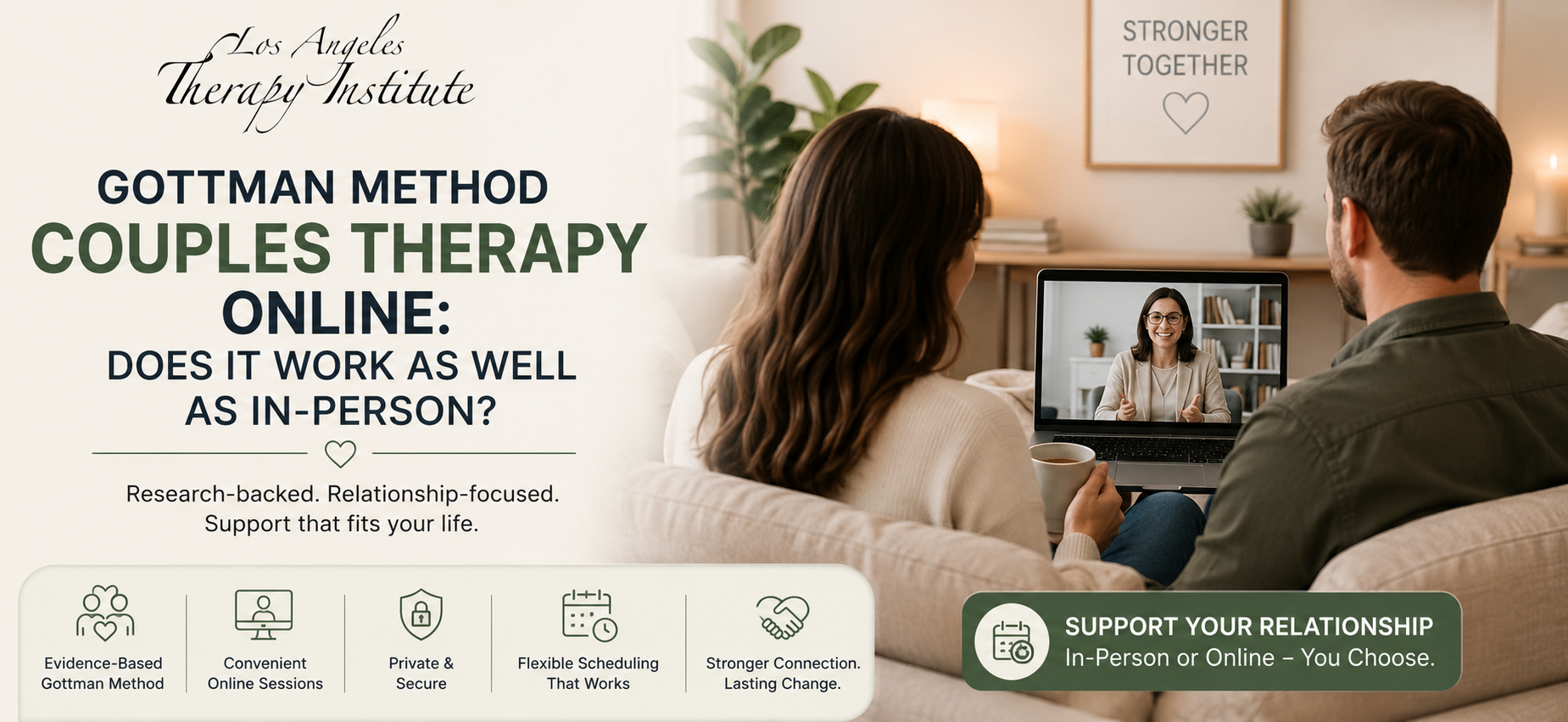
A couple juggling two jobs, a toddler, and a therapist’s office forty minutes away eventually stops going. Not because the sessions weren’t helping, but because getting there became its own source of stress.
That’s the exact gap online therapy was built to close. The question most couples ask before trying it is a fair one: does a video call actually deliver the same results as sitting across from a therapist in person?
The short answer, backed by research and years of clinical practice, is yes for most couples. This guide walks through what Gottman online couples therapy looks like in practice, what the research actually found, and how to know if it’s the right format for your relationship.
Objective: Help couples weighing online versus in-person counseling understand what the research actually says about Gottman online couples therapy, so they can choose a format without second-guessing whether it’ll actually work.
Table of Contents
Key Takeaways
- Research on Gottman online couples therapy shows outcomes comparable to in-person sessions for relationship satisfaction and communication improvement.
- One large study of over 1,100 married clients found teletherapy matched in-person therapy on most outcomes, though the therapeutic bond built somewhat slower online.
- Couples therapy Gottman Institute techniques, like structured exercises and homework, translate well to video sessions.
- Online sessions remove common barriers: commute time, childcare, and scheduling around two work calendars.
- Privacy and internet reliability matter more in online formats and are worth planning for ahead of time.
- Los Angeles Therapy Institute offers both in-person and online Gottman Method sessions, so couples can choose or switch based on what fits their week.
What Gottman Online Couples Therapy Actually Looks Like
A Gottman-based online session runs on the same structure as an in-person one. You and your partner join a secure video call, and your therapist leads the session using the same assessment tools, communication exercises, and conflict-management techniques used in the office.
Sessions typically run 50 to 60 minutes, the same as in person. The therapist can still observe body language, tone, and the moments where one partner shuts down or the other leans in. Video just changes the room, not the method.
Most couples use these sessions for the same reasons they’d seek in-person help:
- Recurring conflict that never quite resolves
- Communication that’s turned into avoidance or shutdown
- Rebuilding trust after a breach
- Preparing for marriage
- Strengthening a relationship that’s already stable
Does the Research Support Online Therapy for Couples?
Yes, largely. A 2024 study published in Psychotherapy Research, which looked at data from over 1,100 married clients, found that teletherapy performed about as well as in-person therapy across relationship satisfaction and sexual satisfaction outcomes.
There was one notable difference. The therapeutic alliance, meaning how connected clients felt to their therapist, developed roughly twice as fast in person as it did online. That doesn’t mean online therapy fails to build trust. It just tends to take a bit longer to get there.
Other studies point in a similar direction. Video-delivered couples therapy has shown improvement in relationship satisfaction and mental health outcomes on par with face-to-face sessions, and that improvement has held up in follow-ups conducted months and years later.
What this means practically: online sessions work. Give the process slightly more patience early on, since the relationship with your therapist may take a couple of extra sessions to feel fully comfortable.
How the Gottman Method Translates to Video Sessions
The core building blocks of the Gottman Method hold up well over video because they rely on structured conversation and observable behavior, not physical proximity.
Love maps. Exercises designed to help partners understand each other’s inner world work the same whether you’re sitting on a couch or on a video call.
Turning toward, not away. Therapists can still catch the small moments where one partner reaches out emotionally, and the other misses it, since these usually show up in tone and word choice, both visible on camera.
Conflict management. Structured techniques for de-escalating an argument, like the “gentle startup,” are taught the same way in both formats and practiced through guided exercises during the session.
Trust and commitment work. Rebuilding trust after a betrayal relies on structured conversation and homework between sessions, both of which transfer to online formats without much friction.
Who Benefits Most from Online Sessions?
Online sessions work well for most couples, but a few situations make it a particularly strong fit.
- Long-distance or dual-location couples. Partners working in different cities, or one traveling frequently, can stay consistent with sessions instead of pausing therapy entirely.
- Busy schedules with young kids. Skipping the commute and childcare scramble makes weekly sessions realistic instead of aspirational.
- Couples who feel more open at home. Some partners find it easier to be vulnerable in a familiar space rather than a clinical office.
- Anyone managing anxiety about in-person appointments. Removing the office visit itself lowers a barrier that keeps some people from starting therapy at all.
A couple juggling opposite work shifts is a good example. Finding a single evening that worked for both of them and a babysitter used to take weeks of back-and-forth. Once they moved sessions online, they stopped missing appointments altogether, and consistency made a bigger difference than either partner expected.
What Gets Harder Online, and How Therapists Adjust
Video sessions aren’t without trade-offs, and a good therapist plans around them rather than ignoring them.
Reading subtle body language. A screen crops out posture and hand gestures a therapist might notice in person. Skilled therapists compensate by checking in more directly and asking clarifying questions in the moment.
Distractions at home. Kids, pets, and notifications can interrupt focus. Setting a private, closed-door space ahead of time solves most of this.
Slower rapport-building. As the research shows, trust with the therapist may take a little longer to develop online. Sticking with the first several sessions, even if it feels slightly less natural at first, usually closes that gap.
Tech issues. A dropped call or lagging audio during a tense moment can break momentum. Testing the connection before the appointment avoids most of this.
What to Look for in an Online Couples Therapist
Not every online therapy option is equal. A few things worth checking before booking:
- Licensure in your state, since telehealth still requires proper credentials
- Specific training in couples therapy, Gottman Institute methods, not just general talk therapy
- A secure, HIPAA-compliant video platform
- Clear expectations about session structure and homework between appointments
- The option to switch to in-person sessions later if that ends up being a better fit
Los Angeles Therapy Institute offers both formats through the same therapists, so couples aren’t locked into one or the other. A free 30-minute consultation is a good way to ask these questions directly before committing.
Cost and Logistics
Online sessions generally cost about the same as in-person ones, since the therapist’s time and training haven’t changed, just the setting.
| Factor | Online | In-Person |
| Session length | 50–60 minutes | 50–60 minutes |
| Typical cost | Comparable to in-person rates | Standard practice rates |
| Commute time | None | Varies by location |
| Insurance coverage | Often covered, confirm with provider | Often covered |
| Scheduling flexibility | Generally higher | Limited by office hours and travel |
Los Angeles Therapy Institute accepts several major insurance plans, including Aetna, Cigna, UnitedHealthcare, and Medi-Cal, for both online and in-person sessions. Confirming your specific benefits during the free consultation avoids surprises later.
Ready to Try It?
Distance, schedules, and busy weeks shouldn’t be the reason a relationship stalls out. Whether online sessions fit better than in-person ones usually comes down to what your week actually looks like, not what works best in theory.
Los Angeles Therapy Institute offers Gottman Method sessions both online and in-person, so you can start where it’s easiest and adjust later if needed. Book a free consultation to talk through which format fits your relationship, or learn more about our couples therapy approach before you decide.
Frequently Asked Questions
Is online couples therapy actually as effective as in-person?
For most outcomes, yes. Research comparing the two formats found similar improvements in relationship and sexual satisfaction, though the bond with the therapist tends to build a bit more slowly online. Give it a handful of sessions before judging fit.
Do we need any special equipment for online Gottman therapy?
Just a reliable internet connection, a device with a camera and microphone, and a private room where you won’t be interrupted. Most couples find a laptop works better than a phone, since the larger screen makes it easier to see each other and the therapist clearly.
Can we switch from online to in-person sessions later?
Usually, yes. Many practices, including Los Angeles Therapy Institute, let couples move between formats depending on what a given week looks like, without starting the process over.
Will the therapist be able to tell what's really going on between us over video?
Skilled couples therapists are trained to read tone, pacing, and word choice closely, all of which come through clearly on video. It may take a session or two longer to build the same comfort level as in-person work, but the therapist’s ability to read the relationship doesn’t disappear.
Does insurance cover online couples therapy the same way it covers in-person sessions?
Often, yes, though coverage depends on your specific plan. It’s worth confirming with your insurer or asking directly during a free consultation before your first paid session.
Mental Health Disclaimer
Disclaimer: This blog is for general educational and informational purposes only and is not a substitute for professional mental health advice, diagnosis, or treatment. If you have concerns about your mental health or relationship, consult a qualified mental health professional for personalized guidance.