
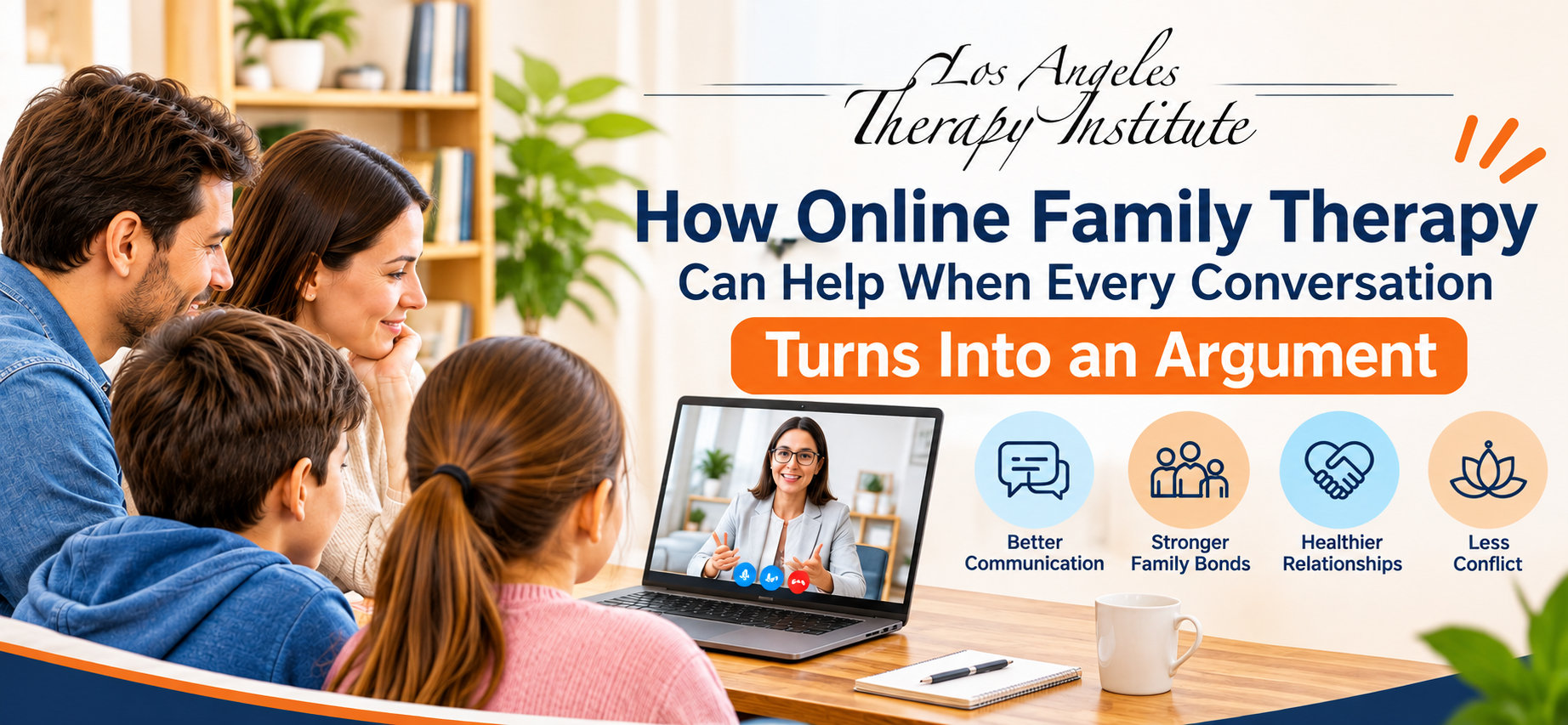
Online family therapy helps by giving your family a calm, guided way to talk, so conversations stop turning into arguments. It started with a simple question: did anyone take out the trash? Ten minutes later, three people are talking over each other, and someone has slammed a door. If that feels familiar, you’re far from alone.
At Los Angeles Therapy Institute, we work on communication and family dynamics, and we also support children, teens, and parents as they face challenges together. With family therapy online, we’re not just aiming to end every disagreement. We’re aiming to help your family handle hard conversations without letting conflict run the show.
Objective: This guide explains why family talks keep turning into fights, what online family sessions look like, which situations they can help, and how to find the right support.
Table of Contents
Key Takeaways
- Arguments that keep coming back usually trace back to misunderstandings, stress, unmet expectations, and communication habits that don’t help.
- In online family therapy, families practise listening, raising concerns constructively, and handling disagreements.
- Parents and couples can learn practical ways to talk about boundaries, responsibilities, and emotional needs.
- Progress often begins with minor changes, not with a home that never has conflict.
- The right therapist, one who understands your family’s needs, is a good place to start.
Why Does Every Conversation Turn Into an Argument?
Family conversations often escalate when people feel criticised, dismissed, or misunderstood. Once someone becomes defensive, the discussion can shift from solving a problem to proving a point.
Consider this example: a parent says, “You never help around the house.” Their teenager hears an accusation and responds, “You always complain.” The parent becomes frustrated, the teenager withdraws, and the original issue remains unresolved.
Several patterns can keep this cycle going:
- Assuming the worst: A question sounds like an accusation, or silence is interpreted as disrespect.
- Bringing up old disagreements: A conversation between partners about one problem quickly turns into a list of past mistakes.
- Listening to respond, not understand: Everyone prepares a defence instead of hearing the other person’s concern.
- Avoiding difficult topics: Unresolved frustrations build until a small disagreement triggers a larger reaction.
- Repeating familiar roles: One partner criticises, the other defends, and everyone expects the same result.
Evaluating these patterns in a timely way helps families understand that conflict is not always about the subject being discussed. Sometimes, it is about how people respond to one another when emotions run high.
How Can Family Therapy Online Help When Conversations Keep Turning Into Arguments?
An experienced family therapist keeps the conversation simple, steady, setting a calmer pace and helping each person put their thoughts into words. You’re not being judged, and nobody’s being sent to the corner. The goal is to understand the pattern your family shares so that you can change it together.
In practice, a therapist might:
- Give each person uninterrupted time to speak.
- Restate what someone said so it lands more gently.
- Spot the moment a talk starts to heat up, and pause it.
- Help the family see the pattern instead of blaming one person.
A 2021 review in the journal Clinical Child and Family Psychology Review revealed moderate-to-strong evidence that telemedicine family therapy is effective for a range of difficulties. Much of the research is focused on children, teens and parents, with less on other forms of family conflict; it’s worth noting.
What Does an Online Family Session Look Like?
It looks a lot like an in-person session, just over video. Here’s a typical flow:
- Getting everyone settled: Family members join the video session from a quiet, private space where possible, and the therapist explains the process and gets everyone started.
- A quick check-in. The therapist asks what has been happening and what each person hopes to discuss.
- One topic at a time. The therapist helps you pick a single issue, not ten.
- A guided conversation. They take turns. The therapist intervenes if things get out of hand.
- A small step for the week. Maybe a short family check-in on Sunday evenings.
A few tips help: pick a quiet spot, use headphones, keep phones out of reach, and place the camera at eye level.
Which Family Situations Can It Help?
It can help whenever communication keeps breaking down. Here are some common ones:
| Family situation | What gets in the way | What sessions work on |
| Parents and a teen | Lectures on one side, eye rolls on the other | Taking turns, listening before reacting |
| Siblings | Fairness, jealousy, old roles | Fair rules and building connection |
| Blended families | New roles and loyalties | Clear expectations and patience |
| After a major change (moving, loss, divorce) | Stress spills into everything | Space to say what’s hard |
| Family members in different places | Few chances to talk well | Regular, structured check-ins |
Is Online Family Therapy the Right Fit?
Online family therapy can suit families who struggle to coordinate schedules, travel to appointments, or meet in the same place. Participants can join remotely as long as they have a suitable device, a reliable connection, and enough privacy to speak openly.
In-person sessions may work better for some families, especially when privacy at home is limited or younger children find it hard to take part on video. A therapist can help you weigh the options based on your family’s circumstances.
If you’re facing threats, intimidation, or violence at home, please contact the National Domestic Violence Hotline at 1-800-799-7233 before starting family therapy. If anyone talks about hurting themselves or someone else, call or text 988.
Can Parents and Couples Get Support Too?
Yes, and it often makes family sessions work better. Sometimes the biggest stress sits with the adults.
If you or someone you know is feeling stretched thin, parent counseling in Los Angeles can provide you with tools for dealing with hard moments and a space to talk about your own stress.
And if most of the tension is between partners, couples therapy for arguing can help you break the same loop, either alongside family sessions or before them.
How Do You Find the Right Therapist?
Find a therapist who is licensed, works with families, and can explain their method properly. Comfort matters, because everyone has to feel safe speaking up.
Consider asking:
- What experience do you have with families like ours?
- How do you involve children or teens?
- How do online sessions work?
- How do we set goals and check progress?
If you’re looking for therapy in Santa Monica, you can meet in person at the practice’s office there, or by video from home.
Let Your Family Hear Each Other Again
Every family argues. What changes things is having a space where everyone gets heard, and a guide who helps. If conversations at home keep ending the same way, reaching out is a practical first step. When you’re ready, a consultation is a simple place to start.
For families searching for the best therapist in Orange County, fit and comfort matter more than any ranking. Los Angeles Therapy Institute has an Orange County office and offers telehealth across California.
Frequently Asked Questions
Is family therapy online as effective as in-person?
For many families, yes. Research is encouraging, especially for children, teens, and parents, though more studies are needed in some areas. Your therapist can tell you if in-person fits better.
Can teens do online therapy?
Yes. Many teens are comfortable with video. Therapists often include time for the teen on their own, as well as family time.
What if one family member refuses to join?
You can start with whoever is willing. Over time, others often join as they see what the sessions are like.
How long does family therapy take?
It depends on your goals and what’s going on. Your therapist can discuss a realistic timeline after the first few sessions.
Do we all need to be on the same screen?
Not always. Some families gather around one device, while others log in separately. Your therapist can recommend what works best.