
Someone drops a pan in the kitchen and a person across the room flinches like they’ve been hit. Nobody else in the house even looks up. That’s not an overreaction. That’s a nervous system still bracing for something that happened years ago.
Trauma doesn’t stay filed away neatly. It sits in the body, half-processed, waiting for a sound or a smell or a certain tone of voice to drag it back into the present. Talking about it for the hundredth time doesn’t always help. Sometimes it just wears a person down further.
That’s the gap EMDR therapy in Santa Monica was built to close. No requirement to relive every detail out loud, session after session. Below is what EMDR actually involves, how it works, and what a first session tends to look like.
Objective: Explain EMDR therapy in Santa Monica in plain terms for someone who’s never set foot in a therapist’s office, and give them a clear next step through Los Angeles Therapy Institute.
Table of Contents
Key Takeaways
- EMDR therapy in Santa Monica helps the brain finish processing a memory that got stuck, using guided eye movements instead of retelling the story over and over.
- You don’t have to describe the traumatic event in detail for it to work. That’s usually the first thing that surprises people.
- Most clients feel a real shift somewhere between session six and session twelve, though a single bad car accident often resolves faster than years of childhood trauma.
- Sessions run 60 to 90 minutes, usually weekly at the start.
- Los Angeles Therapy Institute runs EMDR sessions at both Santa Monica offices and offers a free 30-minute consultation before you commit to anything.
What Is EMDR Therapy?
EMDR stands for Eye Movement Desensitization and Reprocessing. It’s a therapy built around one idea: your brain didn’t finish processing a memory, so it’s still reacting to it like the danger is happening now.
Psychologist Francine Shapiro stumbled onto this in the late 1980s, almost by accident, while noticing that moving her eyes side to side seemed to take the edge off a distressing thought she was having on a walk. That observation eventually became a full clinical method. Most memories fade with time. A handful get frozen instead, and they keep firing off the same fear response years later. EMDR therapy in Santa Monica works by giving the brain another shot at processing that frozen memory the way it should have the first time.
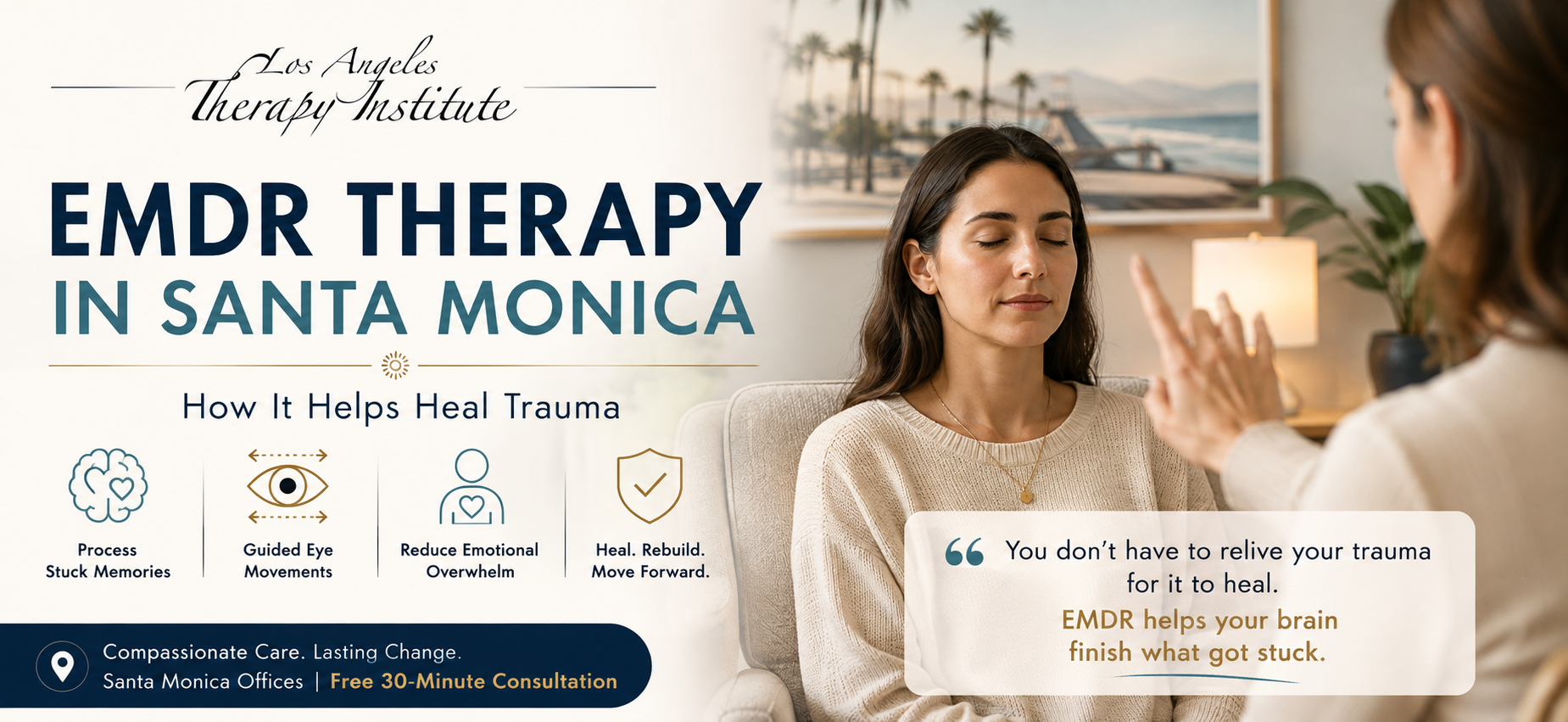
During a session, the therapist guides your eyes back and forth (or sometimes uses alternating taps or tones) while you briefly hold the memory in mind. It sounds almost too simple. Clinically, it’s one of the most researched trauma treatments out there.
How Does EMDR Actually Work?
EMDR moves through a series of stages, but nobody needs to memorize the clinical names to understand what’s happening. Here’s the plain version.
First, your therapist gets to know your history and what brought you in. This isn’t a rushed intake form. It’s a real conversation, and you set the pace on how much you share early on.
Next comes preparation. Before touching any painful memory, your therapist teaches you a few grounding techniques, so you have somewhere to land if things get intense. This step gets skipped by some providers. It shouldn’t be.
Then the actual work starts. You and your therapist pick a specific memory, along with the belief attached to it, something like “I should have done more” or “I’m not safe.” While briefly holding that memory in mind, you follow the guided eye movements. Most people describe this part as strange at first and then oddly calming once they settle into it.
As sessions continue, the emotional weight of the memory drops. A memory that felt like a 9 out of 10 in week one might sit at a 2 by the time it’s fully processed. Your therapist then helps attach a more accurate belief in its place, something closer to “I did what I could with what I knew.” The session always wraps with a calming step, so you’re not walking out mid-process.
What Does an EMDR Session Look Like?
A session usually runs 60 to 90 minutes in a quiet room, one-on-one with your therapist. Most people start weekly and adjust from there.
The first couple of sessions are mostly conversation. Actual reprocessing tends to start around session three or four, once your therapist has enough context and you both feel ready for it. Some clients want to jump in faster. Most therapists will ask you to slow down, and that’s usually the right call.
You stay fully awake and aware the entire time. This trips people up, because EMDR gets confused with hypnosis online, and it isn’t. You can pause, ask questions, or stop at any point without it derailing the process.
A few things that make a real difference:
- Sleep decently the night before if you can.
- Skip scheduling anything demanding right after your session. Processing tends to leave people tired, not energized.
- If a specific memory keeps surfacing on its own, mention it. That’s often exactly what the work needs to focus on.
- Give it time. A single car accident might process in a handful of sessions. A childhood of walking on eggshells around an unpredictable parent usually takes longer.
Who Is EMDR Therapy For?
EMDR started as a PTSD treatment, and it’s still one of the strongest tools for that. But the use has widened well past combat veterans and assault survivors, which is where a lot of people first heard about it.
People who tend to see real results with trauma therapy Santa Monica clients ask for through EMDR include:
- People recovering from a car accident, assault, or a frightening medical event
- Adults still carrying the effects of a chaotic or neglectful childhood
- First responders and nurses who’ve been exposed to crisis after crisis
- Anyone with a phobia or panic response tied back to one specific memory
- People who tried standard talk therapy, felt like they hit a wall, and didn’t know what else to try
It also gets used alongside anxiety and depression treatment when a specific memory is clearly part of what’s keeping someone stuck. Age isn’t much of a barrier either. Adolescents and older adults both respond to it, though the pacing looks different depending on the person.
How Is EMDR Different From Talk Therapy?
The short version: EMDR targets a specific memory using eye movements, while talk therapy works through patterns and feelings mainly by talking them out over time.
| EMDR Therapy | Traditional Talk Therapy | |
| Main tool | Guided eye movements or bilateral stimulation | Conversation |
| Focus | A specific memory and the belief attached to it | Broader patterns, thoughts, relationships |
| How much detail you share | Minimal. You don’t narrate the whole event | Usually more verbal detail over time |
| Typical pace | Often faster for a single traumatic event | Can take longer to reach trauma-specific relief |
| Best fit for | PTSD, one clear traumatic memory | General mental health support, ongoing work |
A lot of clients end up doing both. EMDR handles the memory that keeps derailing them, while regular talk therapy covers everything else going on in their life.
What Should You Look for in an EMDR Therapist?
Formal EMDR training matters here more than it does for general talk therapy. A license alone doesn’t mean someone has been trained in the actual protocol.
Before booking, it’s worth asking:
- Where did you get certified in EMDR, and how many hours of training did that involve?
- How do you decide when someone is ready to start the reprocessing phase?
- What happens if a memory turns out to be more overwhelming than expected mid-session?
- If EMDR doesn’t end up being the right fit, what else do you offer?
At Los Angeles Therapy Institute, EMDR is offered by trained clinicians at both Santa Monica locations, and it’s often paired with the practice’s broader trauma and PTSD therapy services for clients who need more than one approach running at the same time.
How Much Does EMDR Therapy Cost?
EMDR sessions are priced similarly to regular therapy sessions. What changes the total cost is how many sessions your specific situation ends up needing.
| Payment Method | Typical Cost Per Session | Notes |
| Private pay | $150 to $300 | Varies by therapist experience and location |
| In-network insurance | Copay only, often $20 to $50 | Depends entirely on your plan |
| Sessions typically needed | 6 to 20+ | Single-incident trauma often needs fewer than complex or repeated trauma |
Los Angeles Therapy Institute accepts most major insurance plans, including Aetna, Cigna, UnitedHealthcare, Optum, and Medi-Cal. The free 30-minute consultation is a good place to ask about your specific coverage before anything gets booked.
Conclusion
A flinch at a dropped pan. A sleepless night after a smell that shouldn’t mean anything. Trauma doesn’t check in before it shows up. EMDR therapy in Santa Monica gives that stuck memory somewhere to finally land.
If you want to find out whether EMDR is the right fit for what you’re carrying, Los Angeles Therapy Institute offers a free consultation with zero pressure attached. Book your free consultation today or call 3108574946.
Frequently Asked Questions
Does EMDR actually work, or is it just moving your eyes around?
It works, and it’s backed by real clinical research, not just anecdotes. The eye movements are one part of a structured process, not the whole treatment. Studies consistently show it reduces PTSD symptoms, often faster than talk therapy alone.
Do I have to describe my trauma out loud during EMDR?
No. This is usually the biggest relief for people who’ve avoided therapy for years because of this exact fear. You identify the memory and the belief tied to it, but you’re not narrating the full story.
How many sessions does EMDR usually take?
Depends on what you’re working through. A single frightening event might resolve in 6 to 12 sessions. Something like ongoing childhood abuse usually takes longer, since there’s more than one memory involved. Your therapist can give you a better estimate after the first few sessions.
Can EMDR make you feel worse before it gets better?
Sometimes, yes. Some people feel more raw or tired for a day or two after a session where real processing happened. That usually settles quickly. Tell your therapist if it doesn’t, since pacing can be adjusted.
Is EMDR okay for someone who's never done therapy at all?
Yes. You don’t need any prior therapy experience. The preparation stage exists specifically to make sure you have coping tools in place before any memory work starts.