
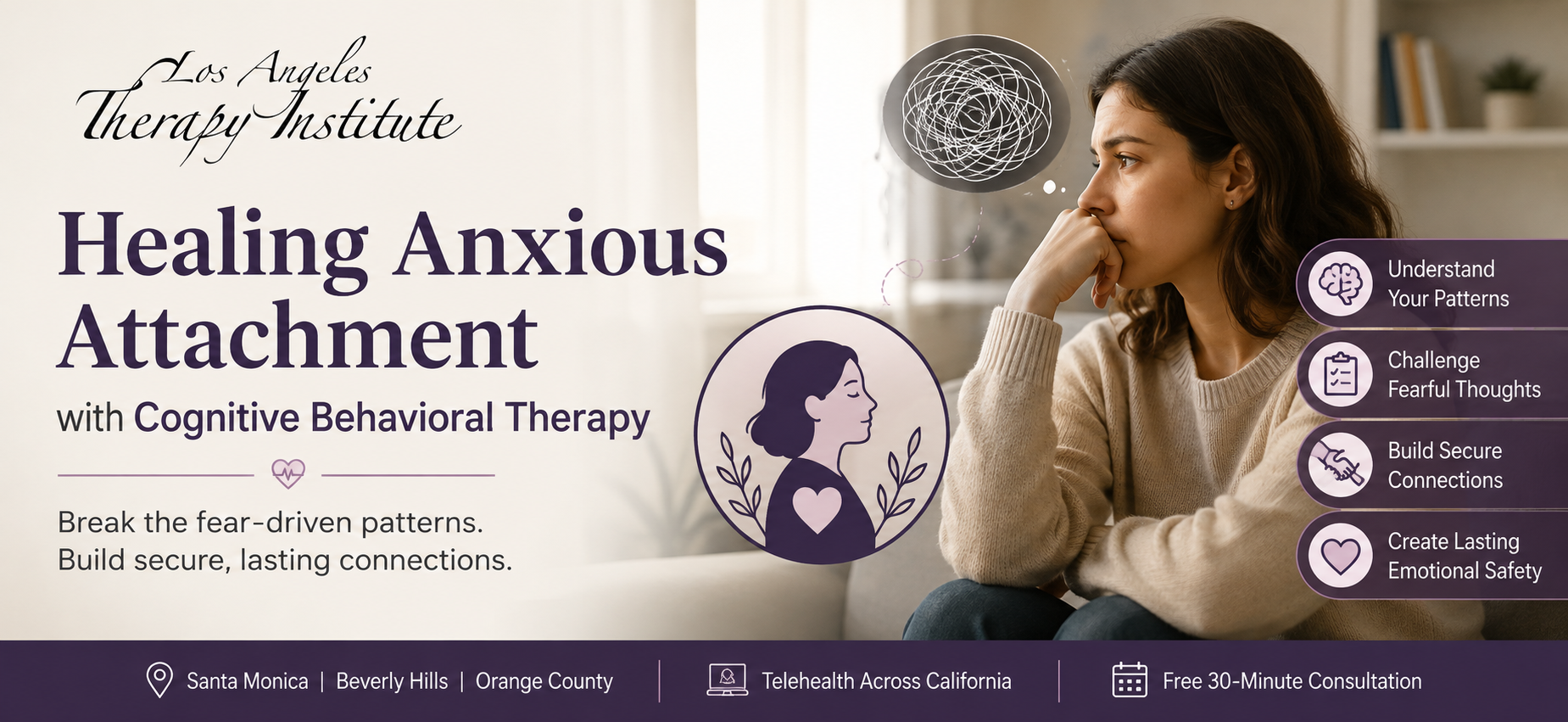
There’s a particular kind of panic that doesn’t look like panic from the outside. It looks like refreshing your messages for the tenth time. It looks like reading the same three-word text over and over, trying to find the hidden meaning in it. It looks like lying awake next to someone you love, convinced, for no real reason, that they’re pulling away.
That’s anxious attachment. And if it’s familiar to you, you already know how exhausting it is to live inside a nervous system that treats a delayed reply like a five-alarm fire.
The good news is that this pattern, however old and however stubborn, isn’t permanent. Cognitive behavioral therapy for anxious attachment gives people a concrete way to interrupt the fear response, question it, and eventually build a different relationship with uncertainty. At Los Angeles Therapy Institute, this is work we do every week, often paired with couples-focused approaches when both partners are ready to dig in together.
Objective: This blog explains what anxious attachment looks like in adult relationships and how cognitive behavioral therapy for anxious attachment helps change the fear-driven patterns behind it, from the clinical perspective of Los Angeles Therapy Institute.
Table of Contents
Key Takeaways
- Anxious attachment comes from early bonding experiences where care felt inconsistent, leading adults to fear abandonment even in stable relationships.
- Cognitive behavioral therapy for anxious attachment works by identifying the automatic thoughts behind relationship fear, then testing them against real evidence.
- Core tools include cognitive restructuring, behavioral experiments, and reducing reassurance-seeking.
- Most clients notice reduced reactivity within 10 to 16 weekly sessions.
- Los Angeles Therapy Institute offers the best cognitive behavioral therapy in Los Angeles for attachment work, often paired with the Gottman Method for couples.
What Anxious Attachment Actually Feels Like
Attachment theory sorts people into a few broad styles: secure, avoidant, anxious, and disorganized, based on how they relate to closeness and distance in relationships. Anxious attachment specifically shows up as a persistent worry that the people you love are one bad day away from leaving.
In practice, that might look like:
- Spiraling over a text that took longer than usual to answer
- Needing your partner to reassure you, again, that everything’s fine
- Replaying conversations later, searching for a sign you missed
- Struggling to just believe someone loves you, even when they’ve shown it a hundred times
None of this makes a person needy or broken. It’s a strategy the body picked up somewhere along the way, one that used to serve a purpose. The problem is that the strategy doesn’t know the danger has passed.
Why This Pattern Develops in the First Place
Most of the time, anxious attachment doesn’t come from neglect exactly; it comes from inconsistency. A caregiver who was loving on Tuesday and distracted on Thursday, present in some moments and checked out in others. A child raised in that kind of unpredictability doesn’t learn that love is absent. They learn that love is real but unreliable, and that you have to stay alert to keep it.
Carry that lesson into adulthood, and it starts running in the background of every relationship, including ones that are actually safe and steady. A partner’s quiet mood gets misread as rejection. A small conflict turns into “this is how it ends.” Sometimes it shows up as picking a fight just to get a reaction, or overextending yourself to feel needed, because being needed feels safer than being loved for no reason.
Other experiences can reinforce it too: a painful breakup, a period of instability, even just a person’s natural wiring. None of this is about blaming anyone, including your past self or your parents. It’s about recognizing that the fear made sense once. It just doesn’t fit the life you’re living now.
There’s also a quieter trap inside all of this: reassurance. Asking “are we okay?” and hearing “yes” feels like relief in the moment, but that relief fades fast, and the question comes back. It works the same way checking a locked door five times does; the checking doesn’t actually make the door more locked. It just keeps the anxiety fed.
How CBT Actually Changes This
Cognitive behavioral therapy doesn’t require someone to excavate every early memory that shaped this pattern. Instead, it works on the thoughts and behaviors keeping the cycle alive right now, which tends to create faster, more tangible relief.
Catching and questioning the automatic thought. A partner takes an hour to text back, and the mind jumps straight to “they’re losing interest.” In session, that thought gets slowed down and examined. What actually happened? What’s the evidence for that story, and what’s the evidence against it, based on the real history of the relationship? Often, the gap between the thought and the facts is wide.
Testing the fear directly. If someone believes they have to respond instantly or their partner will assume they don’t care, a therapist might help them design a small experiment: wait an hour before replying and see what happens. Almost always, nothing happens. That lived experience, not just the logical argument, is what starts to loosen the fear’s grip.
Cutting back on reassurance-seeking. This is often the hardest piece, because it feels counterintuitive to stop doing the thing that brings relief. But learning to sit with the discomfort of not asking a fifth time, and developing ways to soothe yourself instead, is what actually breaks the loop long-term.
A typical session might involve going over a thought record from the week, naming the distortion underneath it (catastrophizing, mind-reading, all-or-nothing thinking), and figuring out the next small experiment to try.
Should You Go Alone or Bring Your Partner?
Individual therapy is usually the better starting point. It gives you room to understand your own patterns without anyone else in the room, and it’s especially useful if you’re single and want to walk into the next relationship differently.
Couples therapy makes sense once both people are ready to look at the dynamic together, especially the common cycle where one partner chases for closeness, and the other pulls back to get space. At Los Angeles Therapy Institute, this often means blending CBT with the Gottman Method, so the anxious partner is learning to regulate their own reactions while both people practice repairing conflict without the chase-and-withdraw spiral taking over.
The Bottom Line
Anxious attachment has a way of convincing you that love needs to be proven again and again, in real time, or it isn’t real. It doesn’t work that way. Cognitive behavioral therapy for anxious attachment is about slowly separating an old fear from the relationship actually in front of you, one thought, one experiment, one steadier moment at a time.
If any of this sounds familiar, Los Angeles Therapy Institute offers attachment-focused CBT in person across Santa Monica, Beverly Hills, and Orange County, and by telehealth statewide. A free 30-minute consultation is a low-pressure way to start figuring out what’s actually driving the fear.
Frequently Asked Questions
Can this actually change, or is it just who I am?
It can change. Attachment style is a learned pattern, not a fixed personality trait, and most people move toward more security with consistent work.
Does my partner have to be in therapy too?
No. Individual CBT works well on its own. Couples sessions are an option, not a requirement, for when both people want to work on it together.
Will I stop caring as much if this works?
No, the goal isn’t less love, it’s less fear steering the relationship. Most clients say they feel more present with their partner, not more distant.
How long does this take?
Many people notice a real shift in their reactivity somewhere between 10 and 16 sessions, though a pattern built over years usually takes ongoing practice to fully settle.
Is this covered by insurance?
Most major plans cover it. It’s worth checking your specific benefits before your first appointment.