
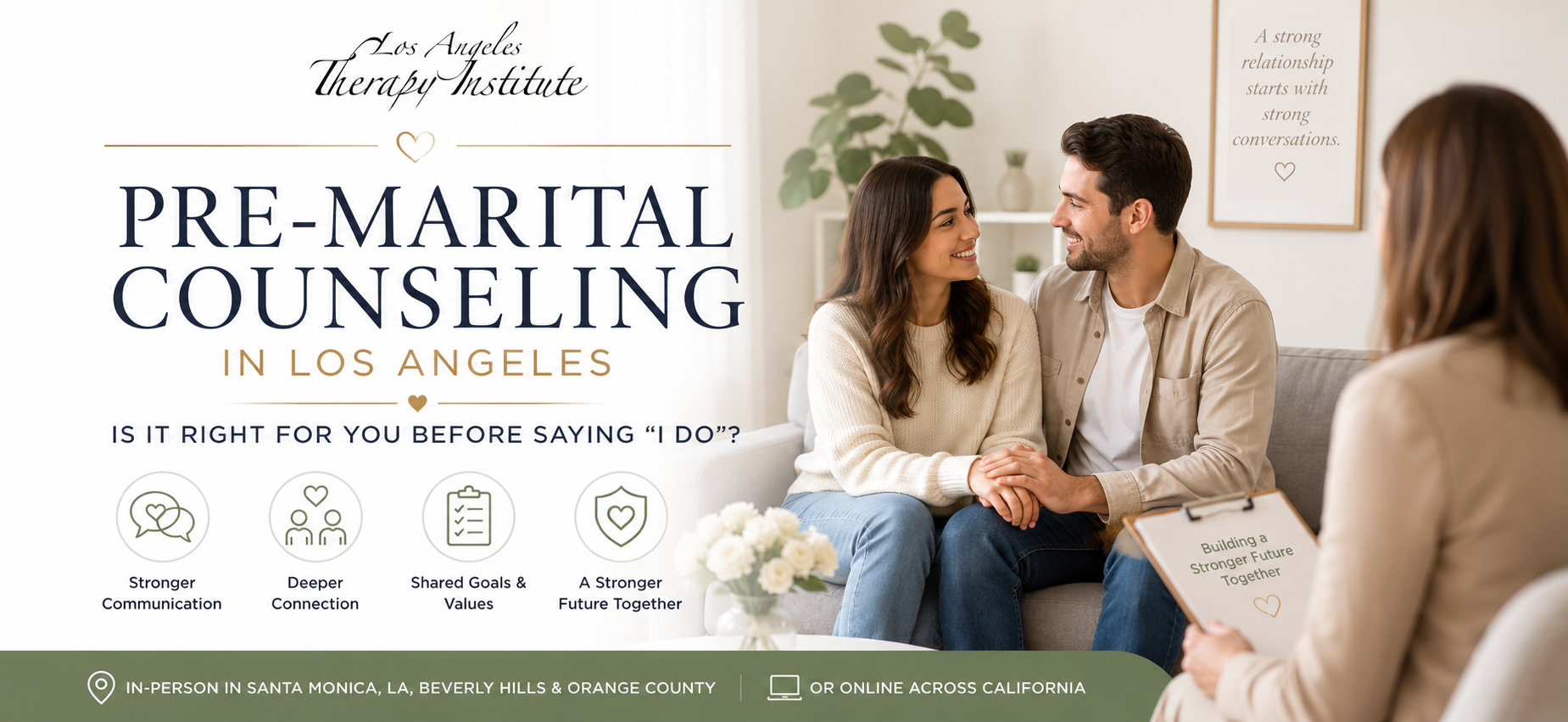
You’ve booked the venue. The dress is picked out. Somewhere between choosing centerpieces and finalizing the guest list, a quieter question tends to show up: do we actually agree on how we want to live together once the wedding is over?
That question is easy to skip past when everything else feels exciting. Most couples don’t fight about the wedding day. They fight, months or years later, about money, in-laws, or how they each picture starting a family, topics that rarely come up naturally during engagement.
Pre marital counseling in Los Angeles exists for exactly this gap. It’s not a sign something is wrong. It’s a structured way to have conversations that are easy to postpone until they’re overdue.
Objective: This blog explains what pre-marital counseling in Los Angeles actually involves, who benefits most from it, and how to decide if it’s worth adding to your wedding prep list. It also covers pre marital counseling online as an option for couples juggling busy schedules or long-distance planning.
Key Takeaways
- Pre-marital counseling isn’t for couples who are struggling. Most people who do it are simply making sure they’ve talked through the big topics before the wedding, not during a crisis after it.
- A typical program runs 4 to 8 sessions and covers money, family, communication style, and expectations around things like kids or career.
- Pre marital counseling online works just as well as in-person sessions for most couples, and it’s often easier to schedule around wedding planning.
- The best time to start is 3 to 6 months before the wedding, early enough to actually use what you learn, not so early that life circumstances shift before the wedding happens.
- Los Angeles Therapy Institute offers both in-person sessions across its Santa Monica, LA, Beverly Hills, and Orange County locations, and online sessions for couples anywhere in California.
What Is Pre-Marital Counseling, Exactly?
Pre-marital counseling is a short series of guided sessions with a licensed therapist, designed to help engaged couples talk through expectations, values, and potential friction points before the wedding.
It’s not relationship therapy in the traditional sense. Nobody’s assuming there’s a problem to fix. Think of it more like a structured conversation with a neutral, trained third party who knows which questions couples tend to avoid.
Sessions typically use an established framework, often something like the Gottman Method, which is built on decades of research into what actually predicts long-term relationship success. At Los Angeles Therapy Institute, Gottman Institute oriented couples therapy forms the backbone of much of this work, since it gives couples concrete tools rather than vague advice.
Do You Actually Need It If Your Relationship Is Good?
Do couples with strong relationships still need pre-marital counseling? Yes, and often they’re the ones who get the most out of it, since a stable relationship gives you room to explore harder topics without the conversation feeling like a crisis.
A common misconception is that counseling is a last resort. In practice, some of the most useful sessions happen with couples who already communicate well. They’re not there to survive a fight. They’re there to make sure two people who love each other are actually picturing the same future.
A few real scenarios where this shows up:
- One partner assumes kids are years away, the other assumes right after the wedding
- Money habits that never came up while dating suddenly matter once finances are shared
- Extended family involvement looks completely different in each partner’s mental picture of married life
None of these are dealbreakers. They’re just easier to navigate with a plan than without one.
What Happens in a Typical Session?
Each session usually focuses on one or two specific topics, guided by a therapist who keeps the conversation productive instead of letting it drift or stall.
A typical first session includes:
- An overview of your relationship history, how you met, what’s worked well, what you’re both hoping to build together
- An initial assessment, often a questionnaire that surfaces areas where you and your partner see things differently
- Setting goals for the remaining sessions, based on what actually matters to your specific relationship
From there, sessions dig into specific topics, one at a time, with practical exercises rather than open-ended chat. Many couples describe it as less like therapy and more like a structured planning meeting for the parts of marriage that don’t show up on a wedding checklist.
Pre-Marital Counseling Online vs In-Person: What’s the Difference?
Pre-marital counseling online covers the same material as in-person sessions, using video calls instead of an office visit. For most couples, the clinical value is identical.
Here’s how the two compare in practice:
| Factor | In-Person Sessions | Online Sessions |
| Location | Santa Monica, LA, Beverly Hills, or Orange County offices | Anywhere in California with a stable connection |
| Scheduling flexibility | Fixed to office hours and travel time | Easier to fit around work or wedding planning |
| Best for | Couples who prefer face-to-face conversation | Long-distance couples, busy schedules, or one partner traveling frequently |
| Session format | Same structured approach, in an office setting | Same structured approach, via secure video |
Neither option is objectively better. It comes down to what actually gets you both showing up consistently, since consistency matters more than the format.
If your schedules are tight leading up to the wedding, pre marital counseling online often ends up being the more realistic choice, simply because it removes the commute.
What Topics Should You Expect to Cover?
A good program doesn’t just ask “are you happy.” It walks through the specific areas that research consistently links to marital stress.
Topics typically include:
- Finances: spending habits, saving goals, and how you’ll handle joint versus separate accounts
- Communication style: how each of you handles conflict, and what you each need during disagreements
- Family and in-laws: expectations around involvement, boundaries, and holidays
- Career and life goals: how you’ll support each other’s ambitions, including relocation or career changes
- Children: whether, when, and how you each picture parenting
- Intimacy: expectations around connection, affection, and how that evolves over time
- Roles and responsibilities: who handles what at home, and how that gets decided together
Not every couple needs equal time on every topic. A good therapist adjusts the focus based on where you and your partner actually differ, not a fixed checklist.
When Should You Start, and How Long Does It Take?
When is the right time to start pre-marital counseling? Most couples benefit most from starting 3 to 6 months before the wedding, early enough to actually use what they learn without rushing through it.
Starting too early sometimes means life circumstances shift before the wedding happens. Starting too late, a few weeks out, means you’re squeezing important conversations into an already stressful stretch of wedding planning.
A typical program runs:
- 4 to 8 sessions total, spaced about one to two weeks apart
- 45 to 60 minutes per session
- Optional follow-up sessions after the wedding, for couples who want a check-in a few months into married life
If your timeline is tighter than that, a condensed version is usually possible. It’s worth mentioning your wedding date early on so your therapist can plan sessions accordingly.
What Does It Cost, and Does Insurance Help?
Pre-marital counseling is typically private pay, since it’s preventive rather than tied to a diagnosed condition, which is how most insurance plans define coverage.
That said, it’s worth checking directly. Some plans do offer partial coverage depending on how sessions are billed, and Los Angeles Therapy Institute works with providers including Aetna, Cigna, Anthem, Optum, and Medi-Cal, among others, for related therapy services.
The clearest way to find out your specific situation is to book a free 30-minute consultation, where you can ask directly about cost, session format, and what a program tailored to your relationship might look like.
Final Word
Wedding planning covers flowers, seating charts, and playlists. It rarely covers the conversations that actually shape a marriage.
Pre marital counseling in Los Angeles gives you a dedicated space to have those conversations with guidance, before they turn into disagreements you’re navigating on your own. Whether that happens in one of Los Angeles Therapy Institute’s offices across Santa Monica, LA, Beverly Hills, and Orange County, or through pre marital counseling online from wherever you are, the goal is the same: walking into marriage with a clearer picture of each other.
If you’re engaged and wondering whether this is worth adding to your plans, book your free 30-minute consultation with Los Angeles Therapy Institute. It’s a low-pressure way to find out what a program built around your relationship could actually look like.
Frequently Asked Questions
Is pre-marital counseling only for couples who are having problems?
No. Most couples who do it have healthy relationships and simply want a structured way to talk through big topics before the wedding, not during one.
How many sessions do we actually need?
Most couples complete their program in 4 to 8 sessions, though this depends on how many topics you want to cover and how much time you have before the wedding.
Can we do sessions separately if our schedules don't line up?
Pre-marital counseling is designed as a joint process, since the value comes from having both partners in the conversation together. Occasional individual check-ins can sometimes be added if needed.
Does pre-marital counseling online actually work as well as in-person?
Yes, for most couples. The structure and content are the same, and video sessions often make consistent attendance easier around a busy wedding schedule.
What if we disagree a lot during a session? Is that a bad sign?
No. Disagreement during a guided session is normal and often the most useful part, since it surfaces things you can actually work through with support, instead of after the wedding.
Do you need to be engaged to start, or can we start earlier?
You don’t need to be formally engaged. Some couples start once marriage is clearly the plan, even before a proposal happens.
What happens after the sessions end? Is there follow-up?
Many couples opt for a check-in session a few months after the wedding, once real married life has settled in and new questions have naturally come up.