
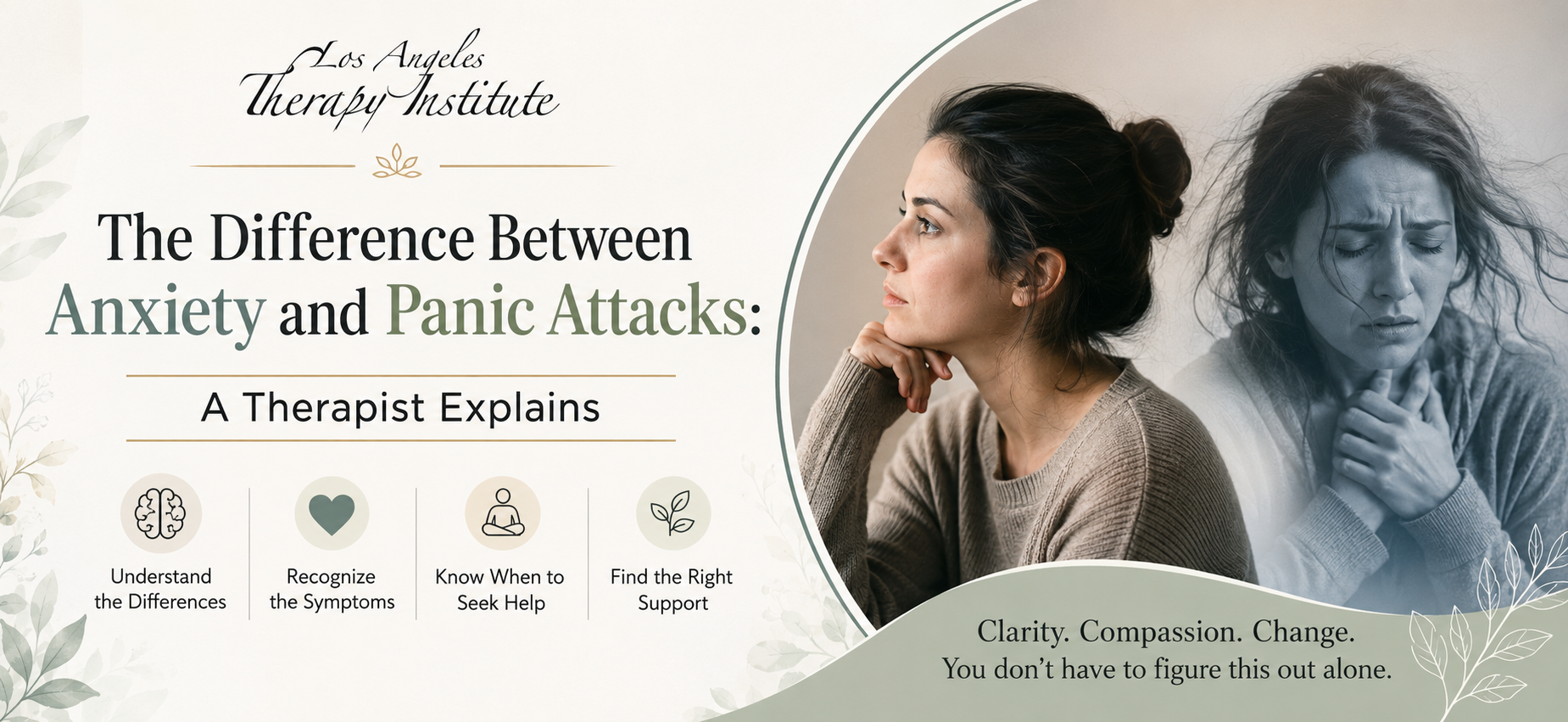
A client once described sitting in traffic on the 405 when her chest tightened, her hands went cold, and a wave of certainty hit her that something was terribly wrong. She thought she was having a heart attack. The ER ruled that out within the hour. What she’d actually gone through was a panic attack, her first one, with no trigger she could point back to.
That kind of confusion comes up constantly in my sessions. People use “anxiety” and “panic attack” as if they’re the same thing, but they’re not, and knowing which one you’re dealing with changes what actually helps. Anxiety vs Panic Attacks isn’t a technicality. It’s the difference between riding something out with a grounding technique and recognizing a pattern that needs more than that.
Anxiety builds slowly and tracks an ongoing stressor, sometimes lasting hours or days. A panic attack hits without much warning, peaks within about 10 minutes, and brings intense physical symptoms like a racing heart or tight chest. Both respond well to therapy once you know which one you’re actually facing.
Objective: Help readers tell the difference between everyday anxiety and a panic attack, so they know what they’re actually dealing with and when it’s worth talking to a therapist.
Key Takeaways
- Anxiety builds gradually and tends to track a specific stressor. Panic attacks arrive suddenly, often with no clear cause
- A panic attack usually peaks within 10 minutes; anxiety can sit at a lower intensity for hours or days
- Anxiety vs. panic attacks isn’t just wording. The distinction shapes how a therapist actually treats it
- Both respond well to therapy, particularly approaches that target the thought patterns underneath them
- A pattern of repeated panic attacks, not a single episode, is usually what brings someone into our office
What’s the Difference Between Anxiety and Panic Attacks?
Anxiety is a sustained state of worry, usually tied to something you can name. A deadline. A hard conversation you’re avoiding. Rent going up again. Panic attacks show up differently: sudden, intense, and frequently without any clear trigger at all.
Timing is the clearest way to tell them apart:
- Anxiety ramps up slowly, often tracking an identifiable stressor over hours or even days.
- A panic attack spikes fast, usually peaking within 10 minutes of the first symptom.
- Anxiety is often anticipatory, worrying about something that hasn’t happened yet.
- A panic attack frequently feels disconnected from any obvious cause, which is part of what makes it so disorienting.
How Does Anxiety Actually Feel Day to Day?
Most people describe anxiety as a low hum that never fully switches off, even when nothing is actively wrong in that moment.
A few things show up again and again in session:
- Worry that’s hard to control or talk yourself out of
- A restless, on-edge feeling that doesn’t have an obvious cause
- Trouble concentrating, or your mind going blank mid-task
- Tight shoulders or a clenched jaw you don’t notice until someone points it out
- Lying awake at night even though you’re exhausted
Anxiety rarely spikes the way a panic attack does. It just stays there, quietly, longer than it should.
What Does a Panic Attack Actually Feel Like?
A panic attack is different in kind, not just intensity. It’s a discrete episode, and the physical symptoms are often what send someone to the ER the first time it happens, the way it did for my client on the 405.
The symptoms tend to cluster together:
- A heart that’s suddenly racing or pounding
- Shortness of breath, sometimes a feeling of choking
- Chest pain or tightness
- Shaking, sweating, or chills
- A sudden sense that something terrible is about to happen
- Dizziness or feeling unsteady
These usually peak within 10 minutes and start to fade after that, though feeling shaky or wiped out afterward can last a good while longer.
Why Do People Confuse the Two?
Part of it is just how we talk. “I had a panic attack” gets used to describe a stressful afternoon that was really just intense anxiety, without the sudden physical surge that defines an actual panic attack.
Part of it is real overlap. Someone with ongoing anxiety can absolutely have panic attacks too, and the anxiety itself often lowers the threshold, making a panic attack more likely under enough pressure. They’re not mutually exclusive, which is exactly why people stop distinguishing between them.
When Should You See a Therapist for This?
One anxious afternoon doesn’t need a referral. A repeating pattern usually does.
A few signs it’s worth talking to someone:
- Panic attacks are happening more than once, especially with no clear trigger
- Anxiety is getting in the way of work, relationships, or basic daily tasks
- You’ve started avoiding places or situations out of fear another attack will happen there
- A doctor has already ruled out physical causes for the symptoms
- The worry sticks around even after the situation that caused it has passed
If any of this sounds familiar, it’s worth speaking with a therapist in Los Angeles who works specifically with anxiety. In my experience, this pattern rarely comes down to weakness or overreacting. It’s usually a nervous system stuck in a heightened state, looking for a way back down.
How Does Therapy Help With Anxiety and Panic Attacks?
Therapy isn’t just about coping in the moment. Done well, it works on the patterns sitting underneath both anxiety and panic attacks.
Cognitive Behavioral Therapy is one of the most researched approaches for both. It helps you spot the thoughts that fuel an anxious spiral and gives you a way to interrupt them before they take over. Our cognitive behavioral therapy for anxious attachment work looks specifically at how early relationship patterns show up as adult anxiety, which is often part of the picture for clients who’ve carried this for years without quite knowing why.
Exposure-based techniques help more directly with panic attacks. They gradually reduce the fear response tied to physical sensations, like a racing heart, so those sensations stop triggering full-blown panic on their own.
Individual therapy for anxiety gives you room to actually unpack what’s driving it, whether that’s work stress, a relationship pattern, or something rooted further back, instead of just managing symptoms as they come up.
None of this happens overnight. It’s built on trust between you and your therapist, and most people notice real change within a few months of showing up consistently.
Conclusion
Anxiety vs Panic Attacks isn’t just semantics. Knowing which one you’re facing changes how you respond in the moment, and what kind of support actually helps over time. If this sounds familiar, Los Angeles Therapy Institute offers a free 30-minute consultation to talk through what you’re experiencing and find the right therapist for you. Book your free consultation or call (310) 857-4946.
Frequently Asked Questions
Can anxiety turn into a panic attack?
Yes. Ongoing anxiety can act like pressure building underneath, making a panic attack more likely once you hit a stressful enough moment. They’re related, not identical, and plenty of people experience both.
Is it normal to think you're having a heart attack during a panic attack?
Very common, and it’s why so many people end up in the ER the first time. Chest tightness, a racing heart, and shortness of breath overlap heavily with cardiac symptoms. If you haven’t had these checked out medically before, it’s worth ruling out other causes first.
How long does a panic attack usually last?
Most peak within about 10 minutes and start easing shortly after that. The aftermath, feeling drained or shaky, can stick around longer, sometimes an hour or more.
Do I need medication, or does therapy handle this on its own?
Plenty of people manage both anxiety and panic attacks with therapy alone, CBT in particular. Others do better combining therapy with medication. That’s a conversation worth having with a psychiatrist alongside your therapist, based on how severe or frequent things are.
How do I know if individual therapy for anxiety is the right next step?
If anxiety or panic attacks are getting in the way of your daily life, relationships, or work, and haven’t eased up on their own, that’s usually the signal to bring it to someone rather than keep managing it alone.